资源简介
 LatestNews

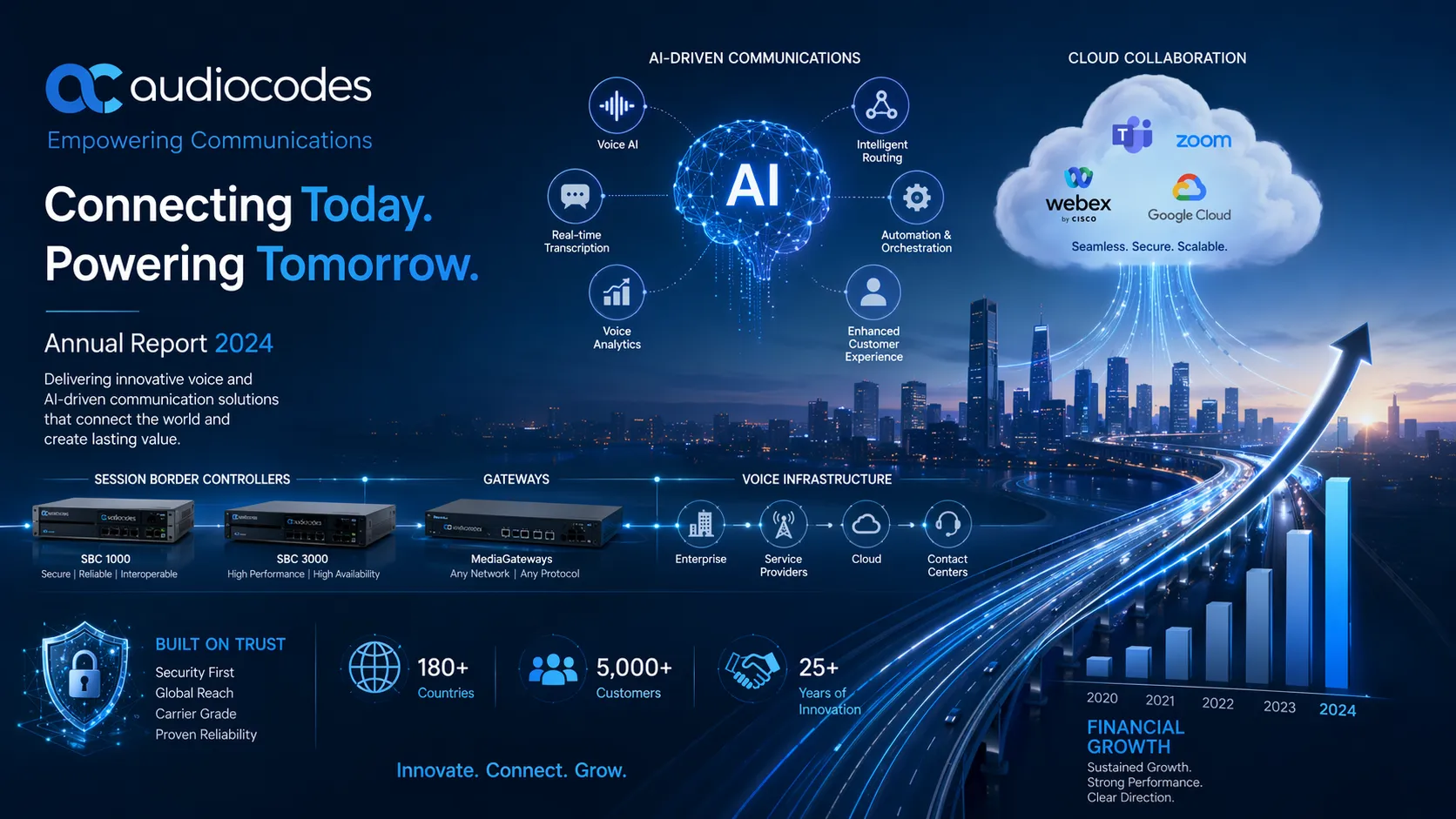
AudioCodes, a publicly listed company required to file annual financial reports, has released its latest annual report, offering investors and industry observers a clearer view of its financial condition, strategic direction, and future growth priorities. More than a routine disclosure, the report provides a useful lens through which to understand the company’s development path, competitive positioning, and long-term investment focus. In simple terms: follow the money.
Confidence remains one of the most valuable signals in the capital market. Following the release of the annual report, stock market sentiment appeared broadly optimistic, suggesting that investors continue to recognize the resilience of AudioCodes’ business and maintain confidence in its future direction.
The report outlines the company’s financial position, governance structure, and market standing, while also emphasizing its reliance on strategic relationships with industry leaders such as Microsoft and Zoom. A significant portion of the filing is devoted to a formal assessment of risks and uncertainties, reflecting the seriousness with which the company views the broader operating environment.
Among the most notable concerns are geopolitical instability and the ongoing conflict affecting Israel, both of which could disrupt operations, planning, and supply continuity. The report also addresses wider structural pressures, including global inflation, fragile supply chains, changing regulatory requirements across multiple international jurisdictions, and the challenge of adapting quickly to technology shifts such as cloud migration and AI integration.
The annual report serves not only as a financial disclosure, but also as a formal statement of the company’s operational uncertainties, strategic priorities, and future direction.
From a regional perspective, AudioCodes’ performance remained broadly healthy. While its domestic market experienced some pressure, other regions continued to record growth. This suggests that the company’s international business remains on a positive path and that demand in overseas markets continues to support expansion.
The regional picture is important because it shows that external disruptions have not undermined the company’s broader global momentum. Instead, AudioCodes appears to be maintaining a relatively balanced business structure, supported by diversified market exposure and continued demand across multiple territories.
At the product level, AudioCodes continues to show strong performance in access-related devices. In particular, its session border controllers and gateways remain among its most competitive product lines and continue to hold a solid position within the global communications market.
In the enterprise session border controller segment, AudioCodes competes with major vendors including Oracle, Ribbon Communications, and Cisco. As SBC deployment scenarios become more complex and more widely adopted, the company has continued to build its reputation around stability in high-concurrency environments, strong security, high reliability, and flexible scalability. These capabilities have helped AudioCodes earn recognition among demanding enterprise and mission-critical users, supported by a broad base of real-world deployment experience.
In China, AudioCodes’ SBC solutions have maintained a leading position among industry users and continue to be widely selected in finance, energy, transportation, and command-and-control environments. For customers operating in these sectors, reliability, service continuity, and secure voice infrastructure remain essential, and AudioCodes has benefited from a strong record in these high-standard deployment scenarios.
In analog, low-density, and medium-density digital gateway markets, AudioCodes faces competition from Ribbon Communications, Cisco, Grandstream, and Sangoma. Even so, its established expertise in enterprise voice connectivity, network migration, and multi-scenario gateway deployment continues to support its market relevance.
As voice networks evolve, infrastructure vendors that combine stability, security, and scalable integration will continue to hold strategic value in enterprise and industry communications.
One of the clearest messages in the report is that artificial intelligence is becoming a fundamental engine of AudioCodes’ future product strategy. This marks an important transition from traditional voice infrastructure toward AI-first software and service models. The company sees AI not as a peripheral enhancement, but as a necessary capability for modern organizations seeking to improve employee productivity, automate customer engagement, and extract more value from enterprise communications.
The shift also reflects a wider market trend. Enterprises increasingly expect communications platforms to do more than transmit voice. They want systems that can understand conversations, generate insights, support automation, and connect voice interactions with broader digital workflows. AudioCodes is positioning itself to respond directly to that demand.
AudioCodes is placing growing emphasis on its VoiceAI business line, which combines conversational AI and machine learning to automate customer service processes and deliver business intelligence. One of the most visible examples is Meeting Insights, an AI-powered solution designed to record, transcribe, and analyze meetings.
Rather than serving only as a recording utility, the platform is positioned to create practical outputs automatically, including meeting summaries, action items, and structured takeaways. This makes the solution relevant not only for documentation, but also for productivity improvement and post-meeting execution.
Another key solution in this strategy is Voca CIC, which the company describes as an AI-first omnichannel contact center solution for Microsoft Teams. It combines conversational IVR, virtual agents, and AI-generated summaries in a single framework intended to improve customer interaction quality while supporting more efficient service delivery.
By embedding AI into the contact center experience, AudioCodes is seeking to align enterprise communications more closely with customer engagement automation. This is an important step as organizations increasingly expect communications systems to support both internal collaboration and external service workflows.
AudioCodes has also introduced Interaction Insights, a SaaS-based recording solution that applies AI-driven analytics to support compliance, quality assurance, and training. In regulated or service-sensitive environments, the ability to go beyond simple call storage and derive structured intelligence from communications is becoming increasingly valuable.
This reflects a larger evolution across the voice industry, where recordings are no longer treated purely as archives, but as operational assets that can improve service quality, risk control, and workforce performance.
Another major part of AudioCodes’ AI strategy is the creation of a connection layer between legacy telephony systems and modern AI ecosystems. Through solutions such as VoiceAI Connect and Live Hub, the company aims to help enterprises integrate large language models and cognitive speech services into existing voice environments.
This approach allows organizations to build generative AI-powered voice bots, virtual agents, and intelligent service workflows without having to replace all of their current communications infrastructure. In practice, this is a highly relevant value proposition for enterprises that want to modernize voice operations while still protecting previous investments.
By bridging traditional voice systems and new AI frameworks, AudioCodes is positioning itself as an enabler of practical enterprise AI adoption rather than simply a legacy voice vendor.
Artificial intelligence is not limited to software and cloud services in AudioCodes’ roadmap. It is also being integrated directly into physical devices and meeting room solutions to improve user experience and collaboration quality.
The company’s RX series room solutions use AI for speaker tracking, noise reduction, and more immersive video conferencing. In parallel, its smart meeting room offerings combine intelligent hardware with automated summary generation and collaboration enhancement features. This shows that AudioCodes is extending AI into day-to-day workplace experiences where productivity gains are visible and immediately measurable.
AudioCodes is also using AI to support the convergence of unified communications and contact center markets. By leveraging cloud collaboration platforms such as Microsoft Teams as a shared foundation for internal teamwork and AI-enhanced customer service, the company aims to reduce IT management overhead while offering a more integrated service environment.
This strategic direction aligns with enterprise demand for simplified architecture, reduced operational complexity, and tighter integration between employee collaboration tools and customer-facing engagement platforms.
At the service layer, AudioCodes is expanding its Live Platform with real-time analytics and AI-based insights. These capabilities are intended to provide service providers and partners with better visibility into usage patterns, service quality, and operational performance.
With more detailed insight into how services are consumed and where quality issues may emerge, partners can support data-driven optimization and more proactive lifecycle management. This adds another dimension to AudioCodes’ value proposition, moving beyond hardware and software delivery toward intelligent operational enablement.
Overall, the annual report presents AudioCodes as a company balancing operational uncertainty with strategic focus. It openly acknowledges the real pressures it faces, including geopolitical volatility, inflation, supply chain fragility, regulatory complexity, and technology transition. At the same time, it demonstrates that the company continues to invest in growth markets, maintain strength in core infrastructure categories, and build a future around AI-enabled communications.
For investors, partners, and enterprise customers, the message is clear. AudioCodes is not simply defending its legacy position in voice infrastructure. It is also working to redefine its role in the next stage of enterprise communications, where cloud platforms, intelligent automation, voice analytics, and AI-powered engagement will increasingly shape market value.
The report suggests that AudioCodes remains financially stable, strategically focused, and committed to long-term transformation, with growing emphasis on AI, cloud communications, and intelligent voice services.
Yes. Based on the interpretation provided, investor sentiment after the report release appeared relatively optimistic, indicating that the market continues to show confidence in AudioCodes’ business and development direction.
Session border controllers and gateways remain among AudioCodes’ strongest product categories, with the company maintaining a competitive position in enterprise voice infrastructure markets.
In the SBC market, competitors include Oracle, Ribbon Communications, and Cisco. In analog and digital gateway markets, competitors include Ribbon Communications, Cisco, Grandstream, and Sangoma.
AI has become a core driver of the company’s product roadmap, supporting meeting intelligence, contact center automation, voice analytics, LLM integration, smart meeting spaces, and service optimization.
The report indicates that AudioCodes will continue evolving from traditional voice infrastructure toward AI-first software, services, and intelligent communications platforms while managing external risks and market change.
底部简介