
LatestNews
Energy infrastructure has always depended on dependable communications, but the risk environment in 2026 is making that requirement more urgent and more visible. Power facilities, oil and gas sites, tank farms, ports, terminals, substations, tunnels, and utility networks are operating under growing pressure from supply uncertainty, safety expectations, operational complexity, and stricter resilience planning. In that environment, communication is no longer a background utility. It is part of the protection system.
When a site faces an equipment alarm, a process upset, a fire risk, a gas leak, a security incident, a logistics bottleneck, or a weather-related disruption, the first few minutes matter. Teams need to hear alerts clearly, contact the right people immediately, coordinate across departments, and maintain communication between field staff and the control room. A modern emergency communication system supports all of those actions with far greater speed and reliability than fragmented legacy tools.
In critical infrastructure, communication reliability is not only an operational advantage. It is part of the site’s safety readiness.
Energy operators are facing a wider range of risks than before. Traditional concerns such as equipment failure, electrical faults, hazardous material exposure, fire, and emergency shutdown events remain important, but they now exist alongside newer pressures. Supply chain volatility, fluctuating fuel conditions, staffing shortages, remote asset management, cybersecurity awareness, and tighter continuity requirements are all changing how facilities think about resilience.
This shift has a direct effect on communication planning. A site may have excellent process equipment and strong safety procedures, but if personnel cannot quickly reach the control room, trigger an emergency call, receive a clear broadcast message, or coordinate across multiple zones, the response can slow down at the worst possible moment. Communication systems therefore need to be treated as core infrastructure, not as optional accessories.
Many industrial and energy facilities are no longer isolated, single-purpose sites. They are connected to remote offices, regional control centers, third-party contractors, maintenance teams, logistics partners, and wider enterprise systems. This means communication flows must move smoothly between field devices, fixed telephones, intercom points, paging systems, dispatch consoles, and mobile users.
When a problem appears in one part of the operation, decision-makers often need visibility and response capability across the whole network. A unified communication architecture helps sites move from local reaction to coordinated incident handling, which is especially valuable when multiple departments or locations are involved.
Facilities in oil and gas, utilities, petrochemicals, marine terminals, transportation, and large industrial environments are expected to demonstrate both preventive safety and emergency readiness. Communication plays a role in both. It supports routine reporting, maintenance coordination, lone worker support, alarm escalation, evacuation messaging, incident recording, and after-action review.
As a result, buyers are increasingly looking for systems that combine emergency telephony, broadcast capability, dispatch visibility, and integration with other safety technologies. The goal is not just to make calls. The goal is to create a communication layer that supports safer operations every day and more effective response during abnormal events.

Communication failures can be expensive, dangerous, and reputationally damaging. In a high-risk environment, even a short delay can lead to confusion, duplicated effort, poor decision-making, or a breakdown in emergency response. If field workers cannot report an issue clearly, if alarms do not trigger the right voice workflows, or if broadcasts are not intelligible in noisy areas, the incident can escalate faster than the organization can manage it.
These risks are not limited to major disasters. Smaller incidents also reveal communication weaknesses. A maintenance team may need immediate support during equipment isolation. A gate area may require a fast security response. A loading zone may need a site-wide announcement. A substation or utility cabinet may need direct voice contact with the control room. Each of these situations depends on robust and easy-to-use communication endpoints.
Many energy and industrial environments are loud, exposed, and physically demanding. Wind, machinery, pumps, compressors, traffic noise, distance, and protective equipment can all affect speech clarity. Consumer-grade devices are rarely suitable for these conditions. Industrial communication equipment must be designed for high-noise intelligibility, acoustic clarity, and reliable operation in harsh settings.
That is why specialized industrial telephones, weather-resistant intercoms, and properly designed PAGA systems remain highly relevant. They provide a communication path that is more predictable, more rugged, and more appropriate for critical tasks.
In some facilities, telephony, paging, alarms, radios, and video platforms still operate in separate silos. That arrangement creates friction during an incident. Operators may need to switch between multiple screens, call groups manually, or rely on personal devices to bridge gaps between systems. That wastes time and increases the chance of mistakes.
Integrated IP-based communication platforms reduce those gaps. By linking voice, broadcast, alarms, intercom, and dispatch functions into one operational workflow, they give supervisors and control room teams a clearer picture of what is happening and what should happen next.
In emergency response, fragmented communication systems do not fail all at once. They fail through delay, confusion, and missed coordination.
A resilient emergency communication solution usually combines several technologies rather than relying on a single device type. The right system design depends on the site, the hazards, the scale of operations, and the response procedures already in place. However, several building blocks appear again and again in modern critical-site deployments.
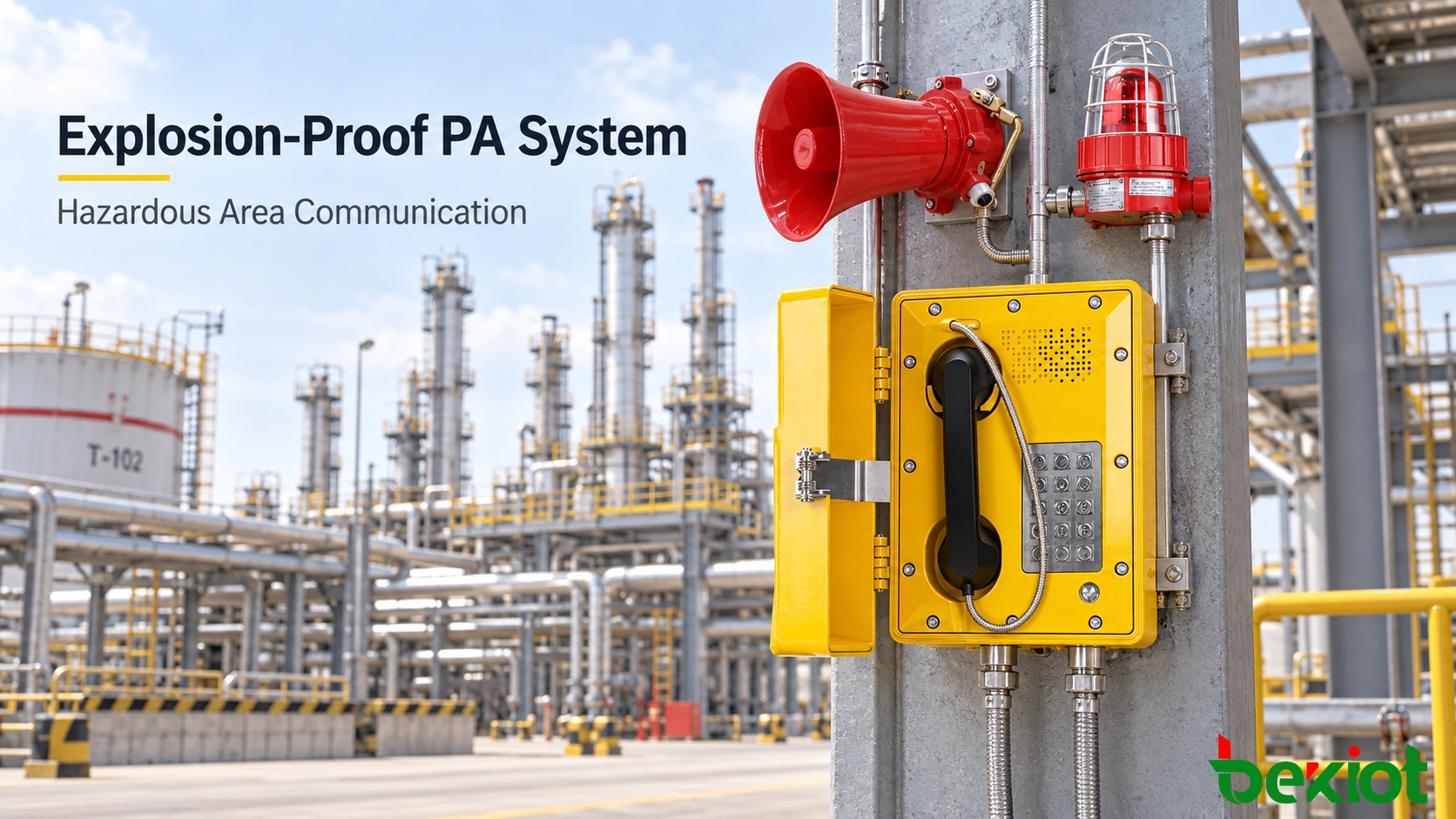
Industrial telephones provide a direct and dependable voice path between field personnel and the control room or support team. They are well suited to fixed locations where users may need one-touch calling, highly visible access to help, glove-friendly operation, and strong environmental protection. In energy and utility settings, these endpoints are often installed in process areas, loading points, perimeter zones, substations, tunnels, corridors, and exposed outdoor locations.
Compared with standard office phones, industrial telephones are built for weather resistance, durability, and long-term use in demanding environments. Their value lies in availability. When a worker needs help quickly, the device should be visible, simple, and dependable.
SIP intercoms are useful where fast, hands-free communication is needed. They can be mounted at entrances, restricted areas, service points, equipment zones, or unmanned facilities to support help requests, remote guidance, security verification, and incident reporting. In some deployments, they also support video, access workflows, or integration with monitoring platforms.
For critical infrastructure operators, SIP intercoms help extend direct communication to more locations without requiring full telephone stations everywhere. They are especially effective when combined with centralized call routing, recording, and dispatch supervision.
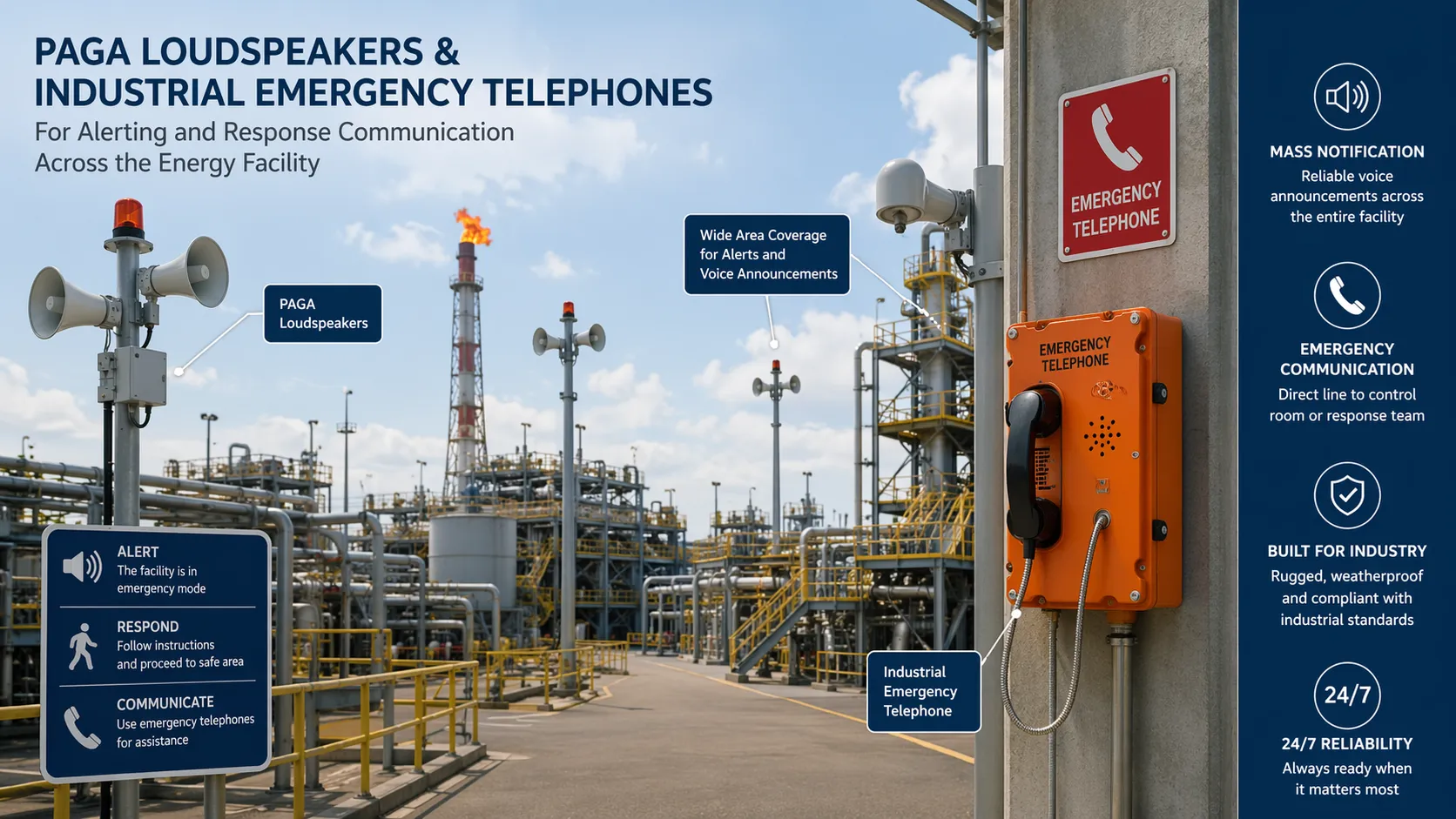
Public Address and General Alarm systems remain essential in large industrial and energy facilities because they communicate to many people at once. During abnormal events, a clear and immediate broadcast can save time, reduce confusion, and support orderly movement. During normal operations, the same system can be used for routine announcements, area paging, shift coordination, and pre-recorded messages.
A modern PAGA system is most effective when it is not isolated. Integration with telephony, alarms, dispatch workflows, and zone control creates a more practical solution. Operators can page specific areas, trigger messages based on conditions, and coordinate announcements with real-time voice communication.

IP PBX platforms form the communication backbone for many modern industrial sites. They support extension management, group calling, call routing, recording, redundancy options, and integration with SIP devices across a wide area network. For multi-site organizations, IP PBX architecture can simplify how offices, control rooms, field stations, and remote support teams communicate with one another.
In emergency communications, the advantage of IP PBX is not only voice connectivity. It is centralized control. Calls can be routed according to role, location, priority, time condition, or escalation logic. That makes the system far more responsive during both normal operations and critical events.
Dispatch consoles bring communication functions together into one operational interface. Operators can monitor calls, answer emergency requests, manage paging, view event priorities, transfer communications, and coordinate with multiple teams. In larger deployments, dispatch software may also link voice workflows with maps, alarms, video feeds, and status information.
This matters because emergency communication is rarely just about one conversation. It is about coordinating several conversations at the same time while maintaining situational awareness. A good dispatch environment helps users do that with less friction and better control.
The need for resilient communication is broad, but some environments benefit especially strongly from integrated emergency communication design. These are typically locations where hazards are high, staff are distributed, outdoor exposure is severe, or response workflows depend on fast escalation.
Refineries, terminals, tank farms, pipeline stations, and processing plants require communication systems that can support both routine operations and emergency scenarios. Fixed communication points, area-wide broadcasts, and centralized dispatch are all important when teams must coordinate under time pressure. In high-risk zones, equipment selection must also reflect environmental and protection requirements.
For these sites, communication infrastructure contributes directly to personnel safety, process continuity, and operational discipline. It also helps teams manage maintenance, shift coordination, contractor access, and alarm response more effectively.
Power plants, substations, water treatment sites, and utility control networks often span large areas with mixed indoor and outdoor assets. Some facilities operate with limited staffing on site, which increases the importance of dependable fixed communication points and centralized voice coordination. Communication systems help operators support alarms, dispatch technicians, coordinate switching activities, and respond to faults or public safety incidents.
Because these operations are infrastructure-critical, resilience and recoverability are major design priorities. Communication systems therefore need to be stable, scalable, and suitable for long service life.
Ports, marine terminals, rail infrastructure, utility tunnels, and industrial logistics zones are busy, noisy, and geographically distributed. Workers may move between operational zones, control points, outdoor areas, and service corridors. Reliable communication helps connect those spaces to a central command function.
In these environments, emergency call points, industrial telephones, intercoms, and paging can improve both incident response and daily efficiency. They provide structured communications that are easier to manage than ad hoc device usage during busy operations.
Choosing the right solution requires more than selecting individual products. Buyers need to consider how the full communication environment will operate during both routine activities and emergency conditions. The best systems are practical, interoperable, and easy to operate under pressure.
SIP and IP-based platforms offer flexibility for scaling across different sites, user groups, and device types. They make it easier to connect industrial telephones, intercoms, paging gateways, IP phones, dispatch platforms, and remote users within a unified structure. They also simplify long-term expansion compared with isolated analog systems.
For organizations that need phased modernization, SIP-based deployment can support gradual upgrades while preserving operational continuity. That is especially useful for critical sites where downtime or abrupt change is difficult to accept.
Emergency communication devices installed in industrial and infrastructure settings must match the environment. That includes protection against water, dust, corrosion, vibration, impact, and temperature extremes. It may also include high-visibility design, hands-free operation, and loud audio performance depending on the application.
Reliable hardware is not a branding detail. It is a functional requirement. The device must remain available when site conditions are at their worst, not only when the weather is good and the workload is light.
Communication works best when it connects with the wider site ecosystem. Integration with CCTV, video management, fire systems, alarms, radio gateways, access control, and industrial monitoring platforms can help operators respond more quickly and with better context. It can also reduce manual steps inside the control room.
For example, a help point call can be linked with nearby video, a site-wide alert can trigger a zoned announcement, or a control room operator can coordinate with radio users and IP endpoints through one dispatch workflow. These are practical advantages that improve real-world response performance.
Critical infrastructure buyers should also evaluate redundancy options, remote maintenance capability, spare strategy, centralized management, and future expansion paths. A lower initial price does not necessarily mean lower long-term cost if the system is difficult to maintain, hard to integrate, or unreliable during demanding conditions.
Strong lifecycle value usually comes from stable architecture, dependable components, open standards, and solution design that matches the customer’s environment. That is why many operators prefer communication vendors that understand industrial use cases rather than only office telephony.
The most effective emergency communication system is the one that remains simple for users, reliable for operators, and adaptable for long-term site growth.
Becke Telcom provides communication solutions designed for industrial and safety-critical environments where reliability, clarity, and system integration matter. Rather than treating telephony, intercom, broadcast, and dispatch as isolated functions, the company focuses on building practical communication architectures that help operators respond faster and manage sites more confidently.
Its solution portfolio can support industrial telephones, SIP intercoms, emergency assistance points, PAGA integration, IP PBX communication, and dispatch workflows for facilities that require strong communication performance in demanding conditions. This approach is well suited to energy infrastructure, petrochemical operations, transportation systems, tunnels, utilities, ports, and other critical environments.
For customers evaluating communication upgrades in 2026, the priority is increasingly clear. A reliable emergency communication system is no longer just a support layer. It is part of operational resilience, worker protection, and site-wide readiness.
Talk to Becke Telcom about building a safer, more resilient communication system for critical infrastructure and industrial operations.
They help facilities respond quickly to alarms, incidents, maintenance issues, and safety events by connecting field personnel, control rooms, and management teams through dependable voice and alerting workflows.
Typical components include industrial telephones, SIP intercoms, PAGA systems, IP PBX platforms, emergency call stations, and dispatch consoles. Many projects also integrate CCTV, alarms, and radio communication.
A PAGA system allows operators to broadcast live or pre-recorded messages to specific zones or entire facilities. It is useful for alerting personnel, coordinating evacuation, and improving communication across wide operational areas.
SIP-based architecture improves scalability, interoperability, and centralized management. It allows different communication endpoints and applications to work together within one IP-based platform.
Oil and gas, petrochemicals, utilities, ports, transport infrastructure, tunnels, mining, heavy industry, and other safety-critical sectors all benefit from communication systems designed for rapid coordination and harsh operating conditions.