

What Is an IP Phone System? Why Businesses Should Get It
An IP phone system is a business communication system that uses Internet Protocol networks to carry voice traffic, manage extensions, and connect internal users with outside callers. Instead of depending mainly on traditional analog lines and older switchboards, it places business telephony on the same network foundation that organizations already use for data, software, and connected devices. In practical terms, that means desk phones, soft clients, branch offices, remote staff, and service lines can operate inside one more unified communication environment.
For businesses, the value of an IP phone system goes far beyond making and receiving calls. It supports extension dialing, call transfer, hunt groups, voicemail, conferencing, call routing, centralized administration, and easier expansion across departments and locations. It also creates a stronger base for integration with front desks, service teams, paging, intercom, and in some projects even dispatch or industrial communication workflows.
This matters because business communication has changed. Many companies now operate across multiple sites, rely on hybrid work, need better customer response handling, and expect their voice system to connect with broader operations instead of sitting alone as a closed phone island. An IP phone system is often the practical step that brings those needs together.
An IP phone system is no longer only a replacement for legacy telephony. For many organizations, it becomes a scalable communications layer that supports daily calling, remote connectivity, and wider operational coordination.
What Is an IP Phone System?
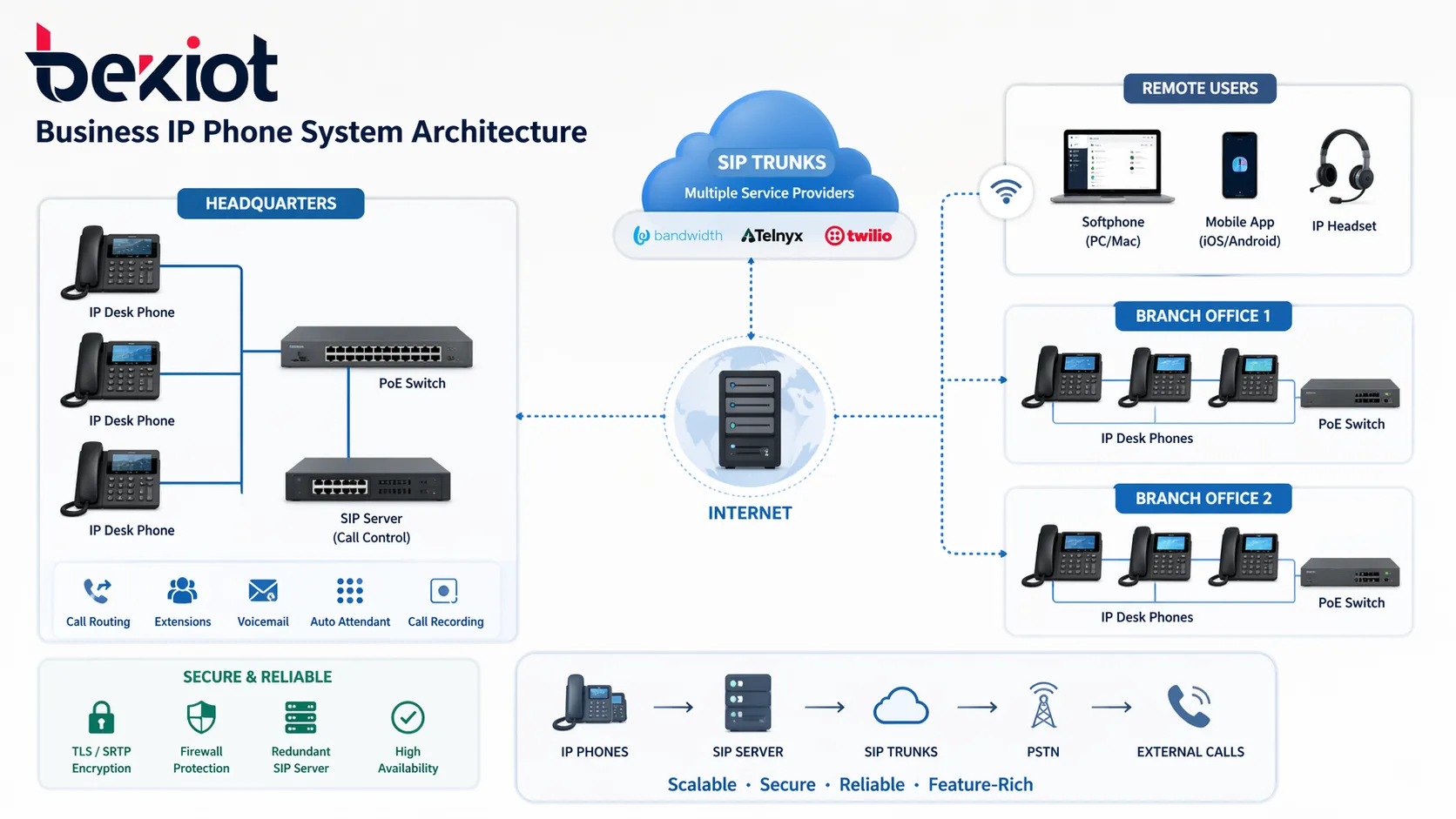
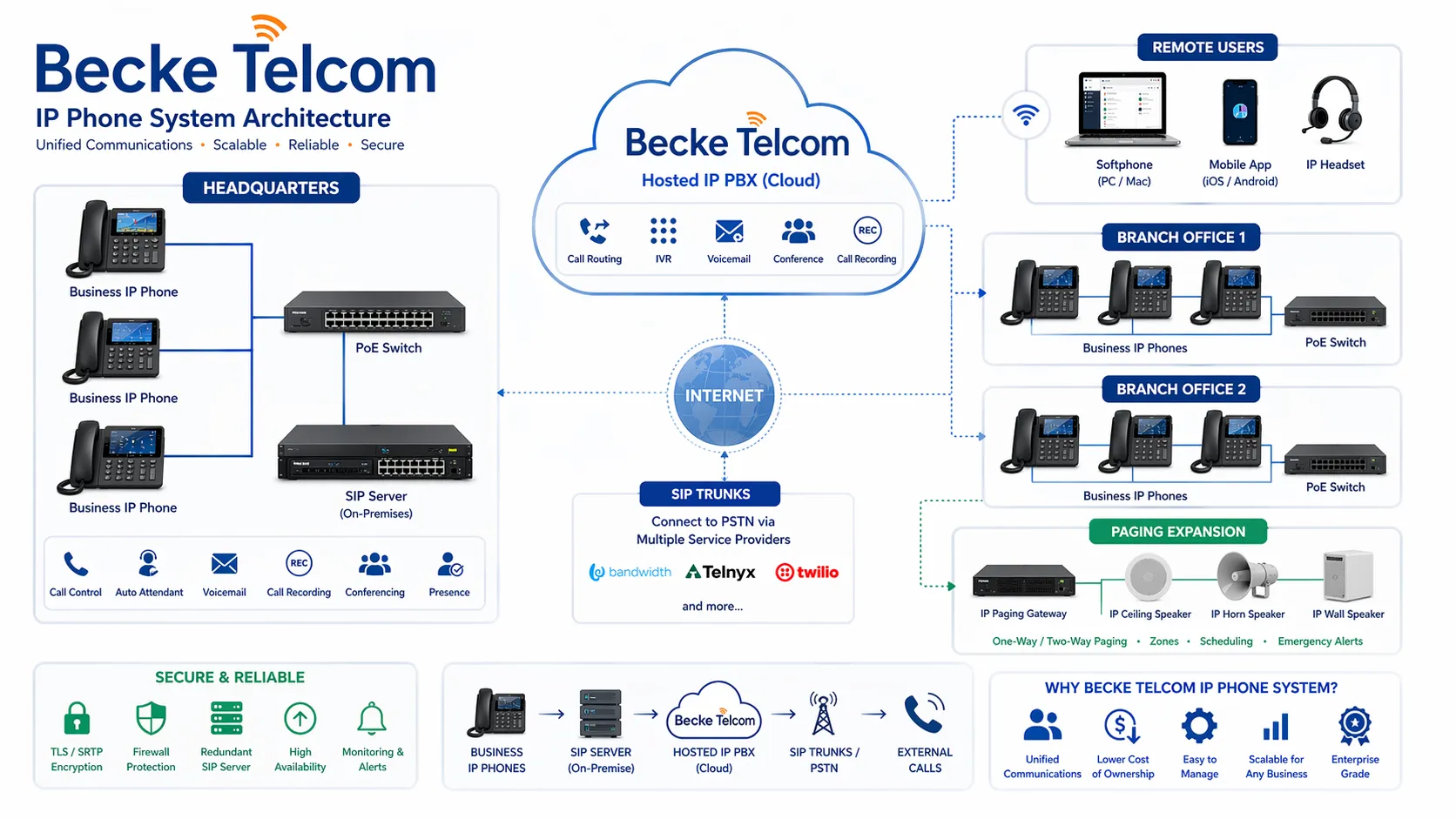
At its core, an IP phone system is a telephony platform built around IP networking. It usually includes user endpoints such as desk IP phones or softphones, a control layer such as an IP PBX or SIP server, external connectivity such as SIP trunks or gateways, and management tools for users, permissions, extensions, and call policies. When these parts are combined, the organization gets a structured voice environment rather than a loose collection of individual phones.
The term is sometimes confused with VoIP, but they are not exactly the same thing. VoIP describes the method of carrying voice over IP networks, while an IP phone system refers to the actual business deployment that uses that method. A company may use VoIP technology in many ways, but an IP phone system is the organized business solution that turns that technology into extensions, call flows, departments, numbers, and operational rules.
Compared with traditional business telephony, the main difference is architectural flexibility. Older systems often depend more heavily on fixed local hardware, dedicated cabling assumptions, and isolated site-by-site deployment. An IP phone system is generally better suited to growth, remote usage, cross-site connectivity, and software-based administration. That is why it is widely adopted by modern offices, service teams, branch organizations, campuses, and mixed office-industrial environments.
How Does an IP Phone System Work?
Core Endpoints: IP Phones and Soft Clients
The user-facing part of the system is usually the endpoint. That can be a desk IP phone on an employee’s desk, a receptionist’s console, a supervisor phone, or a software client running on a laptop or mobile device. Each endpoint registers to the communication platform with an extension or account, which allows it to make internal calls, receive external calls, transfer conversations, and access configured telephony features.
In a Becke Telcom-based deployment, this endpoint layer can include business IP phones such as the BV60P, BV60W, and BV63. These models are positioned for business use, with the BV60P and BV60W fitting common office, front-desk, and general staff roles, while the BV63 is better suited to users who want a color display and more programmable keys for faster operation. This kind of product segmentation is important because not every seat in a company needs the same device profile.
Endpoint design influences the user experience more than many buyers initially expect. A phone that is easy to navigate, stable in registration, and clear in audio quality reduces handling friction throughout the day. For reception staff, managers, and customer-facing teams, this directly affects response speed and call accuracy.
Call Control, Registration, and Business Features
Behind the endpoints sits the control platform. This is typically an IP PBX, SIP server, or closely related call control system that manages registration, extension logic, dial plans, permissions, ring groups, and routing behavior. When a user dials a number, the platform determines where the call should go, whether it should stay internal, whether it should be passed to an outside service, and which policies apply to that session.
This is also where the business functions live. Features such as IVR menus, voicemail, conferencing, extension assignment, department mapping, and administrator controls usually depend on the central platform rather than on the individual phone. In Becke Telcom’s product structure, the SIP Server sits in this core role, helping connect SIP phones, intercom devices, gateways, dispatch terminals, and other IP communication endpoints under one manageable platform.
The benefit of centralized call control is consistency. Instead of configuring isolated devices one by one and hoping the whole system behaves correctly, the organization can manage telephony logic from a more structured core. That becomes increasingly valuable when the business adds new users, opens another office, or needs different routing rules for service desks, management, security, or operational teams.
Connectivity to Outside Networks and Remote Staff
An IP phone system is not limited to internal extension calling. It also needs a path to the outside world. In modern deployments, that connection often comes through SIP trunks, gateways, or cloud-based service models that allow users to place and receive external business calls. This is how a company connects its internal telephony environment with customers, suppliers, partners, and public networks.
The same architecture also supports remote and hybrid work more naturally than many legacy systems. A registered endpoint does not always have to sit in one office on one fixed floor. Remote employees, branch teams, and mobile supervisors can participate in the same numbering plan and communication policies when the system is designed properly. Becke Telcom also presents a hosted IP PBX direction that supports remote access, centralized voice services, and easier expansion without forcing every project into a complex on-site-only model.
For growing businesses, this is one of the strongest reasons to adopt an IP phone system. It lets telephony follow the organization’s operating model instead of forcing the organization to stay inside the limits of its older phone hardware.
Why Businesses Should Get an IP Phone System
Better Scalability Than Legacy Office Telephony
Businesses rarely stay static. Teams change, departments expand, service roles evolve, and new sites are added over time. A communication system that works only for the current office layout often becomes restrictive surprisingly quickly. An IP phone system is generally easier to scale because adding users, extensions, and devices is more software-oriented and network-oriented than in many older telephony environments.
This does not mean every expansion is effortless, because network design, security, QoS, and operational planning still matter. But the overall model is more adaptable. A company can add new desk phones, soft clients, side offices, or specialized communication endpoints without redesigning the entire telephony foundation each time. That makes the system a better fit for organizations that expect change instead of treating communications as a frozen one-time installation.
Improved Support for Multi-Site and Hybrid Work
Modern business communication often spans headquarters, branch offices, warehouses, customer service desks, and remote users. In a traditional setup, each location may feel like a separate island, which creates inconsistent dialing plans, fragmented management, and a less unified caller experience. An IP phone system can bring those users into one more coherent environment with shared numbering logic, centralized policies, and more consistent service handling.
Hybrid work also changes what businesses need from telephony. Calls can no longer be treated as something tied only to one physical desk inside one building. Teams need continuity across office devices, software clients, and managed remote access. An IP phone system makes that possible in a much more structured way, helping businesses keep communication availability aligned with how work is actually done.
More Efficient Call Handling and Administration
Business phone systems are not judged only by audio transport. They are judged by how effectively they help people answer, direct, prioritize, and document calls. A stronger IP phone system improves this through extension structures, transfer logic, ring groups, IVR, voicemail, conferencing, and administrator visibility. Those functions reduce unnecessary manual handling and help calls reach the right person more reliably.
Administrative efficiency matters just as much. IT teams and system administrators benefit from centralized management, cleaner user provisioning, easier policy control, and more consistent maintenance workflows. When communication is managed through one platform instead of scattered across disconnected components, daily operation becomes easier to standardize and easier to grow.
Businesses usually do not adopt an IP phone system only to modernize telephony. They adopt it because they need voice communication to become more scalable, easier to manage, and more compatible with today’s multi-site and service-driven operations.
How Becke Telcom Fits Into an IP Phone System Project
Business IP Phones for Everyday Users
Becke Telcom can be positioned inside this topic not as a single device vendor, but as part of the full IP phone system building stack. On the endpoint side, its IP phone portfolio supports business and industrial communication scenarios. The BV60P and BV60W are practical fits for front desks, standard office users, and general enterprise seating where clear voice, stable SIP registration, and straightforward operation matter more than unnecessary complexity.
The BV63 adds another layer for businesses that want a more feature-forward desktop experience. With its color display and additional DSS keys, it is easier to place in management offices, duty rooms, operator points, and roles that benefit from faster call handling. In other words, Becke does not have to be described as offering one universal phone for every user. It is more credible to explain that different business positions can use different endpoint classes inside the same IP phone system.
That is an important purchasing point. Companies often build better systems when they match device level to user role instead of overspending on every desk or underserving key operational positions.
SIP Server and IP PBX Capabilities for Centralized Control
At the platform layer, Becke Telcom’s SIP Server provides the kind of centralized control that makes an IP phone system useful as a business system rather than a loose collection of endpoints. It supports the connection of SIP phones, intercom devices, gateways, dispatch terminals, and related IP communication nodes while also covering common business functions such as extension organization, routing control, conferencing, voicemail, and administrator-facing management.
This is the layer that gives structure to the entire system. Without a strong control platform, individual phones remain just endpoints. With the right core, the organization can shape departments, branch relationships, inbound logic, internal dialing rules, and service workflows in a more deliberate way. For projects that prefer more cloud-oriented deployment, Becke also presents a hosted IP PBX direction that supports remote access and centralized communication without requiring every function to be built around a heavy local installation model.
For buyers reading this as a business article, the practical takeaway is simple: Becke Telcom can be introduced not only as a phone supplier, but as a vendor whose product stack supports endpoint devices, call control, and broader communication architecture.
Expansion Into Paging, Intercom, and Industrial Communication
One reason this brand fits the topic especially well is that Becke Telcom’s communication story does not stop at office desk phones. Its broader portfolio and solution direction also extend into SIP intercom, paging, broadcast gateways, industrial telephones, and communication environments used in transport, tunnels, petrochemical, offshore, and other demanding sectors. That makes the article more distinctive than a generic office VoIP explanation.
In practical deployment terms, this means an IP phone system can become a wider communication foundation. A business may start with office telephony, then add SIP speakers for announcements, integrate broadcast functionality in selected areas, connect intercom points, or link more specialized field communication devices into the same overall voice environment. This kind of expansion path is one of the reasons many B2B buyers now evaluate IP phone systems as part of a longer-term communications architecture instead of as a simple desk phone refresh.
Common Business Use Cases of an IP Phone System
Office Communication and Front Desk Operations
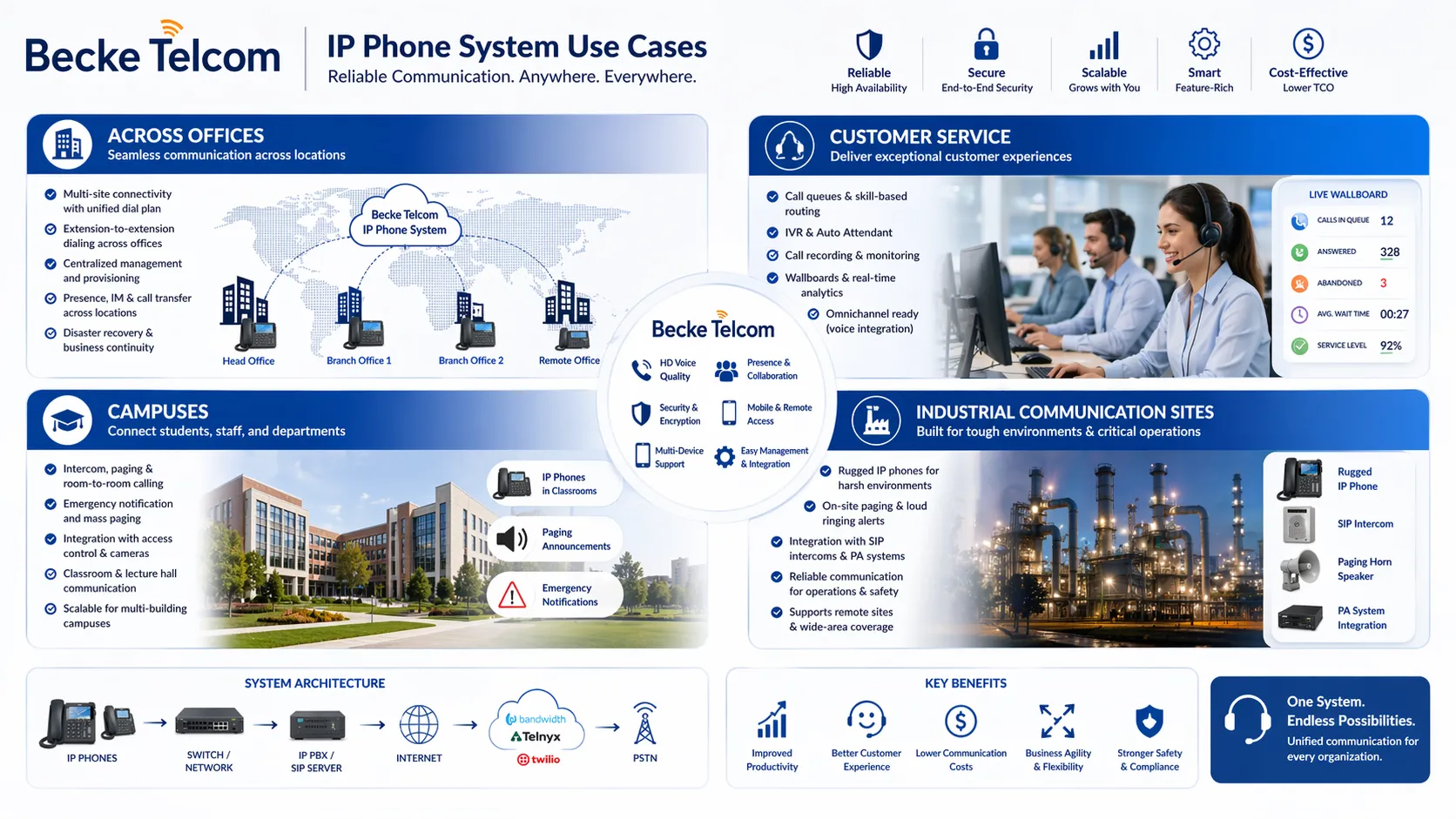
The most familiar use case is still the office. Companies use IP phone systems to support extension dialing, receptionist call handling, departmental transfers, manager availability, conference calling, and structured external communication. In this setting, the system improves day-to-day phone discipline and helps a company present a more consistent communication face to customers and partners.
Front desk roles benefit especially from better visibility and faster call handling, while managers benefit from cleaner extension plans and easier internal reachability. Even in ordinary office environments, the difference between loosely managed phones and a structured IP phone system becomes obvious once call volume, staff count, or customer expectations begin to rise.
Customer Service, Support, and Internal Coordination
Businesses that rely on customer interaction need more than line connectivity. They need controlled call flows, internal escalation paths, and the ability to move conversations between staff without confusion. An IP phone system supports this by giving service teams tools for routing, transfer, conferencing, and more organized call handling across departments.
Internal coordination also improves. Administrative teams, support desks, supervisors, and technical staff can communicate through a more structured extension model instead of relying on ad hoc mobile calling or scattered direct numbers. That strengthens responsiveness without making the communication model harder to manage.
Industrial, Campus, and Mixed-Environment Deployments
Not every business communication project fits the pattern of a single office floor with standard desk phones. Some organizations operate campuses, factories, utility sites, control rooms, or mixed environments where office users, service points, intercom stations, and field communication devices all need to work together. In those cases, the value of an IP phone system lies in its ability to act as a unifying layer for multiple endpoint types.
This is where a Becke-oriented article can stand apart. Because the brand also addresses SIP intercom, industrial telephones, paging, and broader operational communication, the IP phone system story can be extended beyond office voice. For many engineering, infrastructure, and site-based projects, that is closer to reality than a purely office-centric explanation.
IP Phone System vs Traditional Phone System
A traditional phone system can still work well in stable environments with limited complexity, fixed seating, and minimal integration needs. But once a business needs easier growth, multi-site visibility, remote connectivity, or more software-driven management, the limits of older telephony become clearer. The issue is not that traditional systems are always unusable. The issue is that they are often less aligned with how businesses now operate.
An IP phone system is usually the stronger choice when the organization wants one communication structure across offices, remote staff, front desks, specialized endpoints, and future system expansion. It is also more suitable when the business wants telephony to connect with modern workflows rather than remain an isolated utility. In that sense, the decision is often less about replacing old technology for its own sake and more about choosing a communication model that matches the business direction.
Conclusion
An IP phone system is a business communication platform built for flexibility, centralization, and growth. It uses IP networks to connect users, manage extensions, control call flows, and support more advanced business telephony than a basic collection of standalone phones can deliver. For organizations with evolving teams, service responsibilities, multiple sites, or broader communication ambitions, it provides a much stronger long-term foundation than many legacy alternatives.
When the article is viewed through the lens of Becke Telcom, the topic becomes even more practical. The discussion is no longer limited to abstract VoIP theory. It connects directly to business IP phones, SIP Server control, hosted IP PBX options, and the possibility of expanding into paging, intercom, and operational communication. That makes the subject relevant not only to office managers and IT buyers, but also to organizations planning more integrated business and site communication systems.
For companies evaluating their next communication upgrade, the best question is not only whether they need new phones. It is whether they need a more capable communication framework. In many cases, an IP phone system is the answer because it supports the way modern businesses actually work.
Looking for a more scalable business calling environment? Becke Telcom can support IP phone system planning with business IP phones, SIP server capabilities, and broader SIP-based communication expansion for real project needs.
FAQ
What is the difference between an IP phone system and VoIP?
VoIP is the underlying method of carrying voice over IP networks. An IP phone system is the full business deployment built on that method, including phones, accounts, extensions, call control, routing logic, and administrative tools.
Is an IP phone system only for large companies?
No. Small and midsize businesses also benefit from extension dialing, cleaner call handling, easier growth, and better support for remote staff. The right scale depends on the business, but the model is not limited to large enterprises.
Can an IP phone system support remote employees?
Yes. One of the strongest advantages of an IP phone system is that registered users can often be managed more consistently across offices, homes, and branch environments when the platform and network design are planned correctly.
Can an IP phone system do more than desk-to-desk calling?
Yes. In many business projects it also supports conferencing, inbound routing, department logic, remote access, and integration with broader SIP-based devices. In some deployments it can extend further into paging, intercom, and site communication workflows.