What Is Transport Layer Security (TLS)? Uses, How It Works, and Applications
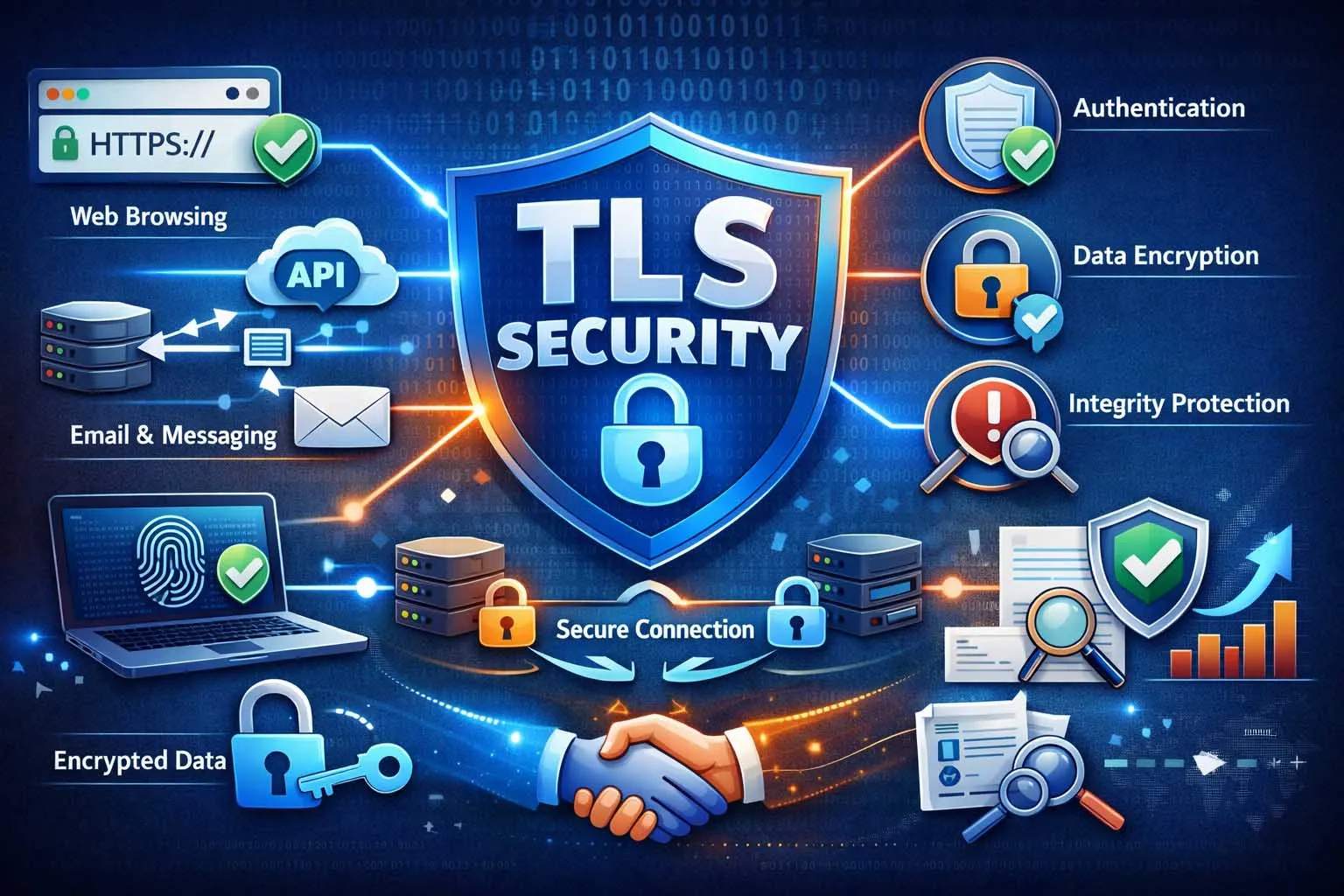
Transport Layer Security (TLS) is the protocol that protects data in transit across websites, APIs, email, and private networks by encrypting sessions, authenticating endpoints, and preserving message integrity.
贝克电信
Transport Layer Security, usually abbreviated as TLS, is a cryptographic protocol used to protect data while it is moving between systems. When a browser opens an HTTPS website, when an application connects to an API, when mail clients communicate with mail servers, or when software components exchange sensitive records across a network, TLS is often the mechanism that creates the protected channel. Its purpose is not only to encrypt traffic, but also to help confirm the identity of the remote endpoint and to detect whether transmitted data has been altered in transit.
In practical deployment, TLS sits between the application layer and the transport connection, adding security controls to ordinary network communication. That is why it is closely associated with HTTPS, secure APIs, modern email transport, VPN-related services, remote administration interfaces, unified communications platforms, and many other connected systems. Without TLS, data crossing a public or shared network can be exposed to eavesdropping, tampering, credential theft, and session hijacking.
TLS is the security layer that turns ordinary network communication into authenticated, encrypted, and integrity-protected communication.
Why TLS Matters in Modern Networks
Protecting Confidential Data in Transit
The most visible role of TLS is confidentiality. Once a secure session is established, the data exchanged between the client and the server is encrypted so that intermediate systems cannot easily read its contents. This is especially important for login credentials, customer records, payment details, operational commands, device telemetry, and any business data that travels across public, wireless, carrier, or multi-tenant infrastructure.
For organizations, this protection is not limited to internet-facing websites. Internal dashboards, cloud workloads, management platforms, microservices, and industrial applications also benefit from strong encryption in transit. Even inside private environments, traffic may pass through switches, gateways, proxies, wireless links, or third-party platforms that make cleartext communication an unnecessary risk.
Authenticating the Remote Endpoint
TLS also helps a client determine whether it is really talking to the intended server. This is typically done through digital certificates and a certificate trust chain. In a website scenario, for example, the browser checks the server certificate presented during the handshake and validates whether it is signed by a trusted certificate authority, whether the certificate is still valid, and whether the hostname matches the requested domain.
This authentication step is essential because encryption alone is not enough. A connection can be encrypted and still be connected to the wrong endpoint. TLS reduces that risk by binding the cryptographic session to an identity that the client can validate according to its trust store and policy rules.
TLS establishes a protected session between communicating systems by combining certificate-based authentication with encrypted data exchange.
Preserving Integrity Across the Session
Beyond confidentiality and authentication, TLS is designed to preserve message integrity. In other words, it helps the communicating parties detect whether traffic has been modified during transit. This matters because network attacks do not always focus on stealing data. In many cases, the real objective is to alter commands, inject content, downgrade security, or manipulate application responses.
Integrity protection is particularly valuable in application control traffic, administrative sessions, voice and video signaling, configuration synchronization, and machine-to-machine communication. When systems depend on accurate signaling and trustworthy payload delivery, integrity is just as important as privacy.
How TLS Works
The Handshake Phase
TLS begins with a handshake. During this initial exchange, the client and server negotiate how they will secure the session. They agree on a supported TLS version, determine the cryptographic parameters to use, authenticate the server, and derive the session keys that will protect the subsequent data stream. In many deployments, this process happens so quickly that end users only notice it as the secure padlock or HTTPS indicator in a browser.
Although the internal details vary by version, the general logic is consistent: the client proposes supported options, the server responds with its selected parameters and identity credentials, the client validates those credentials, and both sides derive shared keys. After that point, the application data is carried inside the encrypted TLS session instead of traveling as readable network traffic.
Certificates and Trust Validation
Certificates are central to the identity side of TLS. A certificate contains identifying information and a public key, and it is digitally signed by a certificate authority or another trusted issuer in the chain. When the certificate is presented, the client checks whether the chain leads back to a trusted root and whether the certificate meets the expected policy conditions.
In enterprise and industrial environments, certificate strategy is often a major operational topic. Organizations need processes for issuance, renewal, revocation handling, private key protection, hostname management, internal public key infrastructure, and service inventory. A technically strong TLS design can still fail in practice if certificates are poorly managed, expired, misissued, or deployed without proper lifecycle control.
Session Keys and Ongoing Encryption
Once the handshake completes, TLS uses session keys to protect the application data flowing through the connection. This is efficient because symmetric encryption is much faster than relying on asymmetric operations for the full session. The public key mechanisms help authenticate and establish trust, while the session keys do the repeated work of protecting ongoing traffic.
Modern TLS deployment also emphasizes forward secrecy. This means that even if a long-term private key were compromised later, previously captured sessions should remain difficult to decrypt, because the session protection depends on ephemeral key exchange material rather than only on the server’s static key. This property is one reason modern TLS configurations are much stronger than legacy deployments.
A TLS session is not just encrypted traffic. It is a negotiated trust relationship with identity checks, key agreement, and integrity protection built into the connection lifecycle.
Key Components of a TLS Deployment
TLS Versions
Version selection has a direct effect on security posture and interoperability. Older protocol versions may remain present in legacy environments, but modern deployments are increasingly centered on TLS 1.2 and TLS 1.3, with TLS 1.3 representing the current generation of the protocol. Version planning matters because outdated support can widen the attack surface, increase compliance risk, and complicate cipher and policy management.
When organizations harden internet-facing platforms, one of the first steps is often to disable obsolete versions and align clients, servers, proxies, and load balancers with modern compatibility baselines. This is especially important for public portals, payment flows, remote access services, healthcare platforms, government systems, and cloud APIs where transport security is a visible part of overall trust.
Cipher Suites and Cryptographic Parameters
TLS depends on carefully selected cryptographic algorithms. These determine how key exchange, authentication, and encryption are handled. In operational terms, administrators need to ensure that weak or obsolete algorithms are removed, that secure defaults are enforced, and that application teams understand the difference between compatibility-driven settings and security-driven settings.
Because different environments have different client populations, cipher planning often involves balancing strong security with real deployment realities. A public website serving modern browsers can usually enforce tighter policy than a mixed environment containing embedded devices, older line-of-business software, industrial terminals, or legacy operating systems. Good TLS design therefore requires both cryptographic discipline and asset visibility.
The TLS handshake defines the security parameters of the session before application data begins to flow.
Certificates, Keys, and Lifecycle Management
Many transport security failures are operational rather than theoretical. Expired certificates, incorrect certificate chains, mismatched hostnames, weak key handling, incomplete renewal automation, and unmanaged internal services can all create outages or security gaps. For that reason, certificate lifecycle management is a strategic part of TLS deployment, not just an administrative detail.
At scale, organizations often need centralized visibility into where certificates are used, when they expire, which teams own them, and how private keys are stored. This becomes even more important in cloud-native environments, distributed applications, service meshes, and industrial platforms where the number of encrypted endpoints can grow quickly.
Common Uses of TLS
HTTPS Websites and Web Applications
The most familiar TLS use case is HTTPS. When a user visits a secure website, TLS protects the browser session and supports server authentication. This makes it foundational for e-commerce, customer portals, knowledge platforms, remote support, online forms, account login pages, content management systems, and cloud-hosted business applications.
For web platforms, TLS is not only a security control but also an operational requirement. Browsers, APIs, federated identity systems, cookie protections, and modern web features all assume encrypted transport as the default condition. In practice, a website without properly configured TLS is increasingly treated as unsafe, incomplete, or non-compliant.
APIs, Applications, and Service-to-Service Communication
Application programming interfaces regularly carry authentication tokens, commands, records, and workflow data between distributed systems. TLS protects these exchanges whether the traffic is moving between a mobile app and a cloud endpoint, between internal microservices, or between enterprise software components across regions and environments.
In service-to-service architectures, TLS is often extended beyond simple encryption to support mutual authentication. In mutual TLS, both ends present certificates, allowing each side to validate the identity of the other. This model is useful in zero-trust environments, regulated networks, controlled B2B integration, and high-assurance machine communication.
Email, Remote Access, and Administrative Interfaces
TLS is also widely used beyond the browser. Email submission and retrieval commonly depend on TLS to secure traffic between clients and servers. Administrative dashboards, remote device management interfaces, conferencing platforms, voice platforms, directory services, and remote application sessions also use TLS to protect credentials and management activity.
For infrastructure teams, this means transport security policy should not stop at the company homepage. Management interfaces, gateway portals, IP communication platforms, dispatch systems, embedded web consoles, and server administration services can be more sensitive than public websites, making TLS hygiene a critical requirement across the full operational estate.
TLS is used across web access, APIs, email, administration, cloud workloads, and system-to-system communication.
TLS Compared with SSL
Why People Still Say SSL
In everyday language, many people still refer to TLS as SSL. This happens because SSL was the earlier family of protocols that became widely associated with secure web sessions and certificates. Over time, the industry moved from SSL to TLS, but the older term remained common in browser messaging, certificate product descriptions, hosting interfaces, and day-to-day conversation.
As a result, terms such as “SSL certificate” or “SSL handshake” are still widely heard even when the deployed protocol is actually TLS. From a technical standpoint, however, modern secure deployments are based on TLS rather than the obsolete SSL protocol family.
The Practical Meaning of the Difference
For operators and buyers, the main point is simple: current secure communication relies on TLS, not on legacy SSL. When evaluating platforms, devices, gateways, or hosted services, the important question is whether they support modern TLS versions, strong certificate handling, and secure cryptographic defaults. Marketing language may still use the legacy term, but the deployment standard should be interpreted through the lens of current TLS practice.
This distinction matters in procurement, compliance review, technical documentation, and product interoperability. A platform that merely says it supports “SSL security” without clear TLS version information can leave too much ambiguity about what is actually implemented.
“SSL” remains a common label in the market, but the secure protocol expected in modern deployments is TLS, typically TLS 1.2 or TLS 1.3.
Where TLS Is Applied in Real-World Environments
Enterprise and Cloud Platforms
Enterprise software increasingly depends on TLS across public websites, private applications, API gateways, SaaS integrations, identity flows, storage access, and internal east-west traffic. In cloud environments, TLS helps create a consistent baseline for protecting data in motion even when workloads are distributed across multiple zones, providers, and automation layers.
This also supports governance. Security teams can define transport policies for application ingress, service communication, remote administration, certificate rotation, and tenant isolation. In many organizations, TLS has become one of the most visible control layers tying together security architecture, platform engineering, and compliance operations.
Industrial, IoT, and Edge Communication
TLS is also relevant in industrial and edge environments where devices, gateways, servers, and management platforms exchange commands, configuration data, event records, and operational telemetry. As operational technology becomes more connected to IP networks, the need for secure transport grows along with the number of remote touchpoints.
In these environments, the deployment challenge is often broader than simply enabling encryption. Teams must consider certificate distribution to field devices, resource constraints on embedded systems, version compatibility, update cycles, network segmentation, and how transport security interacts with industrial protocols, remote maintenance, and centralized monitoring platforms.
Unified Communications and Secure Signaling
Communication systems also use TLS to protect signaling and service access. IP telephony platforms, SIP-based applications, conferencing systems, dispatch consoles, web management portals, and unified communication services can all rely on TLS to secure registration, management access, signaling control, and application integration.
In those cases, transport security contributes to more than privacy. It helps protect credentials, reduce the risk of signaling manipulation, support trusted platform access, and create stronger boundaries between users, servers, gateways, and integrated applications across distributed communication networks.
Deployment Considerations and Best Practices
Prefer Modern Versions and Eliminate Obsolete Support
A strong TLS posture begins with protocol hygiene. Organizations should define supported versions deliberately, phase out obsolete options, and test interoperability before exposing services to production traffic. Leaving older versions enabled for convenience can create long-term weakness, especially when legacy clients are poorly inventoried or rarely used.
In most modern scenarios, the objective is to keep the environment aligned with current best practice while maintaining only the minimum compatibility that the business truly requires. This should be validated not only on origin servers, but also on reverse proxies, load balancers, application gateways, CDN edges, email services, and management interfaces.
Manage Certificates as an Ongoing Program
Certificate operations should be treated as a lifecycle discipline. Teams need reliable issuance, renewal, deployment, inventory, revocation awareness, monitoring, and alerting. The operational maturity of certificate management has a direct effect on service availability because certificate mistakes can break trusted communication just as effectively as a network outage can.
Automation is especially valuable when environments contain large numbers of applications, containers, gateways, edge devices, and internal services. The more distributed the architecture becomes, the less practical it is to depend on manual certificate tracking and ad hoc renewal processes.
Test Configuration, Not Just Connectivity
Many teams confirm that a service is reachable over HTTPS or another TLS-enabled protocol and assume the work is complete. In reality, deployment quality depends on more than successful connection establishment. The full configuration should be reviewed for version support, certificate chain accuracy, hostname coverage, renewal resilience, redirect handling, mutual authentication behavior where applicable, and policy consistency across production and staging environments.
Configuration review is also important after platform upgrades, appliance replacements, operating system changes, certificate authority transitions, or application migrations. TLS is deeply tied to libraries, proxies, trust stores, and service endpoints, so even routine infrastructure changes can affect the transport security outcome.
Conclusion
Transport Layer Security is one of the foundational security technologies of the modern connected environment. It protects data in transit, helps clients verify who they are communicating with, and preserves the integrity of the session from handshake to encrypted data exchange. Whether the scenario involves a public website, an internal API, a cloud workload, a remote management portal, an email platform, or a machine-to-machine application, TLS is often the mechanism that makes that communication trustworthy.
Understanding TLS is therefore not only a matter of knowing that traffic is encrypted. It means understanding how identity is validated, how keys are negotiated, how versions and algorithms affect risk, and how certificate operations influence both uptime and security. In real deployments, good TLS practice is a combination of sound protocol choice, disciplined certificate management, and continuous configuration governance.
FAQ
Is TLS the same as SSL?
No. TLS is the successor to SSL. People still use the term “SSL” informally, but modern secure communication is based on TLS rather than the older SSL protocol family.
What does TLS actually protect?
TLS primarily protects data in transit. It helps provide confidentiality through encryption, validates the identity of the remote endpoint through certificates, and supports integrity protection so that tampering can be detected.
Where is TLS commonly used?
TLS is commonly used in HTTPS websites, APIs, cloud applications, email services, administrative portals, remote management interfaces, and service-to-service communication across enterprise and industrial environments.
Why is certificate management important for TLS?
Certificates are central to trust validation. If certificates expire, are misconfigured, use the wrong hostname, or are deployed with weak key handling, secure communication can fail or become less trustworthy even if TLS is technically enabled.
Which TLS versions are generally expected today?
Modern deployments generally focus on TLS 1.2 and TLS 1.3, with TLS 1.3 representing the newest major version in current use. Legacy versions should be reviewed carefully and phased out where possible.
We use cookie to improve your online experience. By continuing to browse this website, you agree to our use of cookie.
Cookies
This Cookie Policy explains how we use cookies and similar technologies when you access or use our website and related services. Please read this Policy together with our Terms and Conditions and Privacy Policy so that you understand how we collect, use, and protect information.
By continuing to access or use our Services, you acknowledge that cookies and similar technologies may be used as described in this Policy, subject to applicable law and your available choices.
Updates to This Cookie Policy
We may revise this Cookie Policy from time to time to reflect changes in legal requirements, technology, or our business practices. When we make updates, the revised version will be posted on this page and will become effective from the date of publication unless otherwise required by law.
Where required, we will provide additional notice or request your consent before applying material changes that affect your rights or choices.
What Are Cookies?
Cookies are small text files placed on your device when you visit a website or interact with certain online content. They help websites recognize your browser or device, remember your preferences, support essential functionality, and improve the overall user experience.
In this Cookie Policy, the term “cookies” also includes similar technologies such as pixels, tags, web beacons, and other tracking tools that perform comparable functions.
Why We Use Cookies
We use cookies to help our website function properly, remember user preferences, enhance website performance, understand how visitors interact with our pages, and support security, analytics, and marketing activities where permitted by law.
We use cookies to keep our website functional, secure, efficient, and more relevant to your browsing experience.
Categories of Cookies We Use
Strictly Necessary Cookies
These cookies are essential for the operation of the website and cannot be disabled in our systems where they are required to provide the service you request. They are typically set in response to actions such as setting privacy preferences, signing in, or submitting forms.
Without these cookies, certain parts of the website may not function correctly.
Functional Cookies
Functional cookies enable enhanced features and personalization, such as remembering your preferences, language settings, or previously selected options. These cookies may be set by us or by third-party providers whose services are integrated into our website.
If you disable these cookies, some services or features may not work as intended.
Performance and Analytics Cookies
These cookies help us understand how visitors use our website by collecting information such as traffic sources, page visits, navigation behavior, and general interaction patterns. In many cases, this information is aggregated and does not directly identify individual users.
We use this information to improve website performance, usability, and content relevance.
Targeting and Advertising Cookies
These cookies may be placed by our advertising or marketing partners to help deliver more relevant ads and measure the effectiveness of campaigns. They may use information about your browsing activity across different websites and services to build a profile of your interests.
These cookies generally do not store directly identifying personal information, but they may identify your browser or device.
First-Party and Third-Party Cookies
Some cookies are set directly by our website and are referred to as first-party cookies. Other cookies are set by third-party services, such as analytics providers, embedded content providers, or advertising partners, and are referred to as third-party cookies.
Third-party providers may use their own cookies in accordance with their own privacy and cookie policies.
Information Collected Through Cookies
Depending on the type of cookie used, the information collected may include browser type, device type, IP address, referring website, pages viewed, time spent on pages, clickstream behavior, and general usage patterns.
This information helps us maintain the website, improve performance, enhance security, and provide a better user experience.
Your Cookie Choices
You can control or disable cookies through your browser settings and, where available, through our cookie consent or preference management tools. Depending on your location, you may also have the right to accept or reject certain categories of cookies, especially those used for analytics, personalization, or advertising purposes.
Please note that blocking or deleting certain cookies may affect the availability, functionality, or performance of some parts of the website.
Restricting cookies may limit certain features and reduce the quality of your experience on the website.
Cookies in Mobile Applications
Where our mobile applications use cookie-like technologies, they are generally limited to those required for core functionality, security, and service delivery. Disabling these essential technologies may affect the normal operation of the application.
We do not use essential mobile application cookies to store unnecessary personal information.
How to Manage Cookies
Most web browsers allow you to manage cookies through browser settings. You can usually choose to block, delete, or receive alerts before cookies are stored. Because browser controls vary, please refer to your browser provider’s support documentation for details on how to manage cookie settings.
Contact Us
If you have any questions about this Cookie Policy or our use of cookies and similar technologies, please contact us at support@becke.cc .