
IndustryInsights
At Becke Telcom, we view an industrial telephone as far more than a calling device. In real facilities, it is often part of the safety chain, the maintenance process, and the emergency response workflow. It may be installed in a tunnel, on a roadside, inside a utility corridor, at a wind farm, in a plant area, or at an unattended outdoor point where reliable communication is essential and ordinary office equipment is simply not built to survive.
That is why selecting the right industrial telephone should never begin with price alone or with a quick comparison of product photos. It should begin with the site itself. The right choice depends on the environment, the communication task, the required safety level, and the system architecture behind the endpoint. In many projects, the telephone must do more than support voice calls. It may also need to fit into a wider communications framework that includes SIP calling, dispatch, CCTV linkage, paging, emergency help points, or integration with mobile and radio users.
Becke Telcom focuses on industrial and critical communications, so our recommendation is simple: choose the device as part of the full facility communication strategy, not as a standalone hardware item. When the selection is done correctly, the result is stronger reliability, clearer communication, faster response, and lower lifecycle risk.
The best industrial telephone is not the one with the longest feature list. It is the one that matches your environment, your workflow, and your communication architecture from day one.
Every facility places different demands on communication equipment. A wind farm, industrial park, highway, tunnel, utility corridor, process area, or transport site may all require rugged communications, but the environmental risks are not identical. Some locations face heavy rain, direct sunlight, dust, and temperature swings. Others deal with vibration, confined spaces, corrosive air, or continuous machine noise. In many industrial projects, maintenance access is limited, which means the communication endpoint must remain dependable over long periods with minimal intervention.
This is why Becke Telcom always recommends defining the site conditions before selecting the model. Review whether the point is indoor or outdoor, covered or exposed, clean or dirty, attended or unattended, quiet or high-noise, and routine-use or emergency-use. Once those basics are clear, it becomes much easier to determine what kind of enclosure, audio performance, and system capability the device actually needs.
Industrial communication projects often fail when the endpoint is selected too generically. A device may work on paper, yet still create voice issues, maintenance problems, or integration limitations once installed in the field. The stronger approach is to make the facility conditions the foundation of the selection process.
Rugged design is important, but rugged design should always be specific to the site. An outdoor roadside telephone may need strong weather resistance and anti-corrosion protection. A tunnel or corridor installation may need a design that performs well in reverberant spaces. A distributed industrial site may require consistent mounting standards so replacement and maintenance stay simple over time.
Becke Telcom recommends looking beyond broad words such as rugged or durable and instead asking practical questions. Will the unit face washdown or direct rainfall? Could it be exposed to impact or vandalism? Is the installation point narrow, echo-prone, or difficult to service? Does the project require a consistent hardware platform across many sites? These answers help define what type of industrial telephone will truly perform well after deployment.
A strong industrial telephone should not just survive the environment. It should remain usable, serviceable, and acoustically effective in that environment over the long term.
One of the most important early decisions is whether the site needs a standard rugged industrial telephone or an explosion-proof model. Many projects involve harsh environments without involving hazardous-area classification. Highways, wind farms, utility corridors, campuses, transport infrastructure, and general outdoor industrial areas may need heavy-duty telephones, but not necessarily explosion-proof equipment.
However, where flammable gas, vapor, or combustible dust may be present, the selection logic changes completely. In those cases, the device category must match the classified area and the applicable project safety requirements. A high-protection housing on its own is not a substitute for proper hazardous-area compliance.
At Becke Telcom, we encourage project teams to confirm this point early. It is one of the most critical distinctions in industrial communication procurement, and getting it wrong can lead to redesign, compliance issues, and operational risk.
In many facilities, communication equipment is reviewed by more than one team. Operations, engineering, safety, and procurement may all be involved. That is why industrial telephone selection should include a shared understanding of whether the environment is simply tough or formally hazardous. This choice will affect the terminal type, installation practices, accessories, and sometimes even the cable and enclosure strategy.
It is also wise to think ahead. Some projects begin in non-hazardous areas and later expand into adjacent process zones. If that kind of expansion is likely, it may influence how the communication architecture is planned from the beginning.
In industrial communications, harsh conditions call for rugged design. Hazardous conditions call for compliant design. The two are related, but they are never the same decision.
An industrial telephone should never be treated as an isolated endpoint. It needs to work naturally within the facility’s communication architecture. Some sites still rely on traditional analog infrastructure. Others are now based on IP and SIP communications. Many modern facilities want the flexibility to connect industrial telephones with IP PBX platforms, SIP intercoms, paging systems, dispatch consoles, mobile users, and other operational communication tools.
This is where Becke Telcom places strong emphasis on compatibility and system thinking. A telephone may appear suitable as a standalone device, but if it cannot integrate smoothly with the wider platform, it can quickly become a communications island. For long-term value, the terminal should match the network design, the control-room workflow, and the facility’s expansion path.
In many new projects, SIP-based deployment provides a stronger foundation because it makes scaling, remote management, and cross-system integration much easier. For sites that still depend on legacy systems, a phased migration path with gateways may be the most practical solution. The key is to align the telephone with the architecture you have today and the architecture you are likely to need tomorrow.
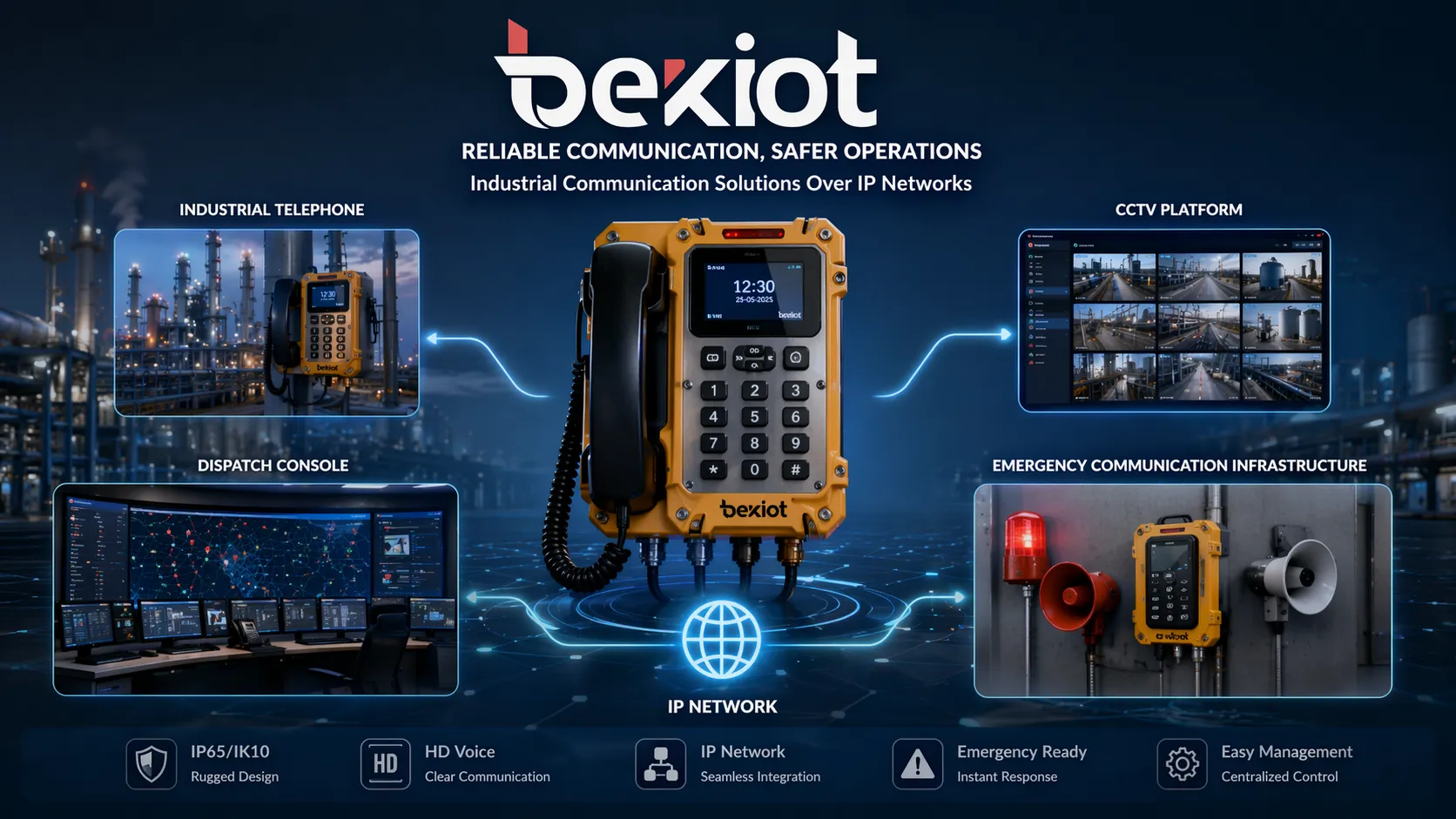
In real industrial facilities, the telephone is often tied to much more than simple voice communication. A help point may need to alert a control room, link to nearby video, support recording, trigger an escalation path, or connect field staff and supervisors quickly. In some projects, it may also need to work with paging, emergency broadcast, dispatch software, or radio interoperability workflows.
Becke Telcom recommends evaluating open integration capability early in the project. This includes protocol compatibility, platform readiness, and the ability to fit into existing or future unified communication, intercom, or dispatch systems. A product that looks inexpensive at the beginning can become costly if it limits integration later.
The more critical the site, the more important integration becomes. In those environments, the industrial telephone is not just a voice endpoint. It becomes part of the operational response infrastructure.
Industrial sites are rarely quiet. Wind, traffic, pumps, engines, ventilation, mechanical systems, and structural echo can all reduce intelligibility. This is why Becke Telcom always advises customers to assess audio performance under real conditions instead of relying only on lab-style demonstrations or marketing language.
In a high-noise facility, the real question is simple: can users hear clearly and be heard clearly when it matters most? That means looking at loudspeaker output, microphone behavior, hands-free performance, echo control, and noise-reduction capability. In critical environments, small differences in acoustic design can make a major difference during normal operations and an even bigger difference during emergency use.
Industrial communication quality should be judged by speech intelligibility in the actual acoustic environment. That is the standard that matters to operators, maintenance staff, and control-room personnel.
Different facilities use industrial telephones for different jobs. Some are primarily for routine maintenance communication. Some are used as emergency help points. Others may support roadside assistance, line-side communication, control-room coordination, or unattended-point calling. The audio design should match the operational purpose.
If the device will be used for emergency calling, users should be able to activate it quickly, hear instructions clearly, and speak without complicated interaction. If it will support longer maintenance conversations, stable duplex communication and consistent voice quality may matter more. In many industrial sites, hands-free communication is preferred because users may be wearing gloves, carrying equipment, or responding under time pressure.
At Becke Telcom, we believe clear audio is not a bonus feature. In industrial environments, it is one of the core requirements that determines whether the endpoint is genuinely useful.
Not every industrial telephone serves the same operational purpose. Some are used for routine field communication with a control room or maintenance office. Others are installed specifically for one-touch emergency assistance, incident reporting, remote support, or unmanned-site protection. If the purpose is unclear, the wrong product can easily be selected.
Becke Telcom recommends identifying the device role before any model comparison begins. If the terminal is meant for emergency use, the requirement may include one-touch hotline calling, hands-free communication, automatic escalation, call forwarding, recording, video linkage, or broadcast coordination. If the unit is primarily for routine operations, the feature priorities may be different.
Function-led selection is one of the clearest ways to improve project outcomes. It prevents overbuying in simple applications and underbuying in critical ones.
Every field telephone is connected to a workflow. When someone presses the call button, who answers? What happens if that person is unavailable? Should the call move to a supervisor, a duty engineer, a control room, or a mobile phone? Does the event need to be recorded? Should nearby cameras or alarms be linked automatically?
These questions are central to the selection process because they determine whether the endpoint will support real-world response. A well-chosen industrial telephone should fit naturally into the operational process behind it, not just into the wall it is mounted on.
For Becke Telcom, this is one of the biggest differences between consumer-style product selection and professional industrial communication planning. The endpoint matters, but the workflow behind the endpoint matters just as much.
Installation is often more demanding in industrial projects than in commercial office projects. Wall surfaces may vary, cable routes may be long, power may be limited, and weather or corrosion exposure may influence how the device is mounted. Before finalizing a model, confirm whether the project needs wall mounting, column mounting, enclosure integration, or deployment as part of a roadside, tunnel, plant, or help-point structure.
It is also important to think about adjacent devices and accessories. Some projects require external speakers, warning lights, cameras, signage, or sensor interfaces. Others may need weather hoods, anti-vandal features, or integration with access control and alarm inputs. These practical requirements should be considered during selection rather than added later as an afterthought.
Becke Telcom recommends looking at the full installation package early. This helps avoid hidden costs, redesign, and deployment delays once the project enters implementation.
The purchase cost of the telephone is only one part of the total project value. Industrial endpoints are usually expected to remain in service for years, which means remote management, maintenance efficiency, product consistency, and spare-part planning all matter. In distributed facilities such as highways, wind farms, campuses, corridors, and large industrial sites, even a small reduction in maintenance visits can create meaningful long-term savings.
This is why Becke Telcom encourages customers to evaluate lifecycle value rather than entry price alone. A product that costs less on day one but creates failures, service overhead, or integration limitations can easily become the more expensive option over time.
The right industrial telephone is the one that delivers dependable performance, easier management, and lower operational risk throughout the life of the facility.
Industrial telephones can look similar in brochures while performing very differently in the field. Choosing by enclosure appearance, surface-level specifications, or lowest price often leads to poor results. Two products may both claim to be rugged, yet only one may be truly suitable for the site’s acoustic, environmental, and integration demands.
Becke Telcom recommends using a structured comparison based on environment, hazard level, communication architecture, noise conditions, operational function, and response workflow. That approach usually produces a much more reliable decision than comparing products in isolation.
Another common mistake is buying for the immediate point only, without considering how the facility may evolve. Many sites later want CCTV linkage, dispatch integration, paging coordination, mobile access, radio interoperability, or remote device management. If the original telephone cannot support broader system development, replacement may be required sooner than expected.
Future-ready selection does not mean choosing the most complex product every time. It means choosing a platform and endpoint strategy that can grow with the project and support a more unified communication environment when needed.
The strongest industrial telephone decision is usually the one that prevents future communication bottlenecks before they appear.
Choosing the right industrial telephone for your facility means looking well beyond the device itself. You need to understand the environment, distinguish between harsh and hazardous conditions, match the endpoint to the communication architecture, evaluate voice performance under real noise conditions, define the operational functions, and plan for installation and long-term maintenance.
At Becke Telcom, we approach industrial communication from the perspective of real operating environments and real system requirements. Whether the application involves routine communication, emergency calling, site-wide integration, or long-term modernization, the right industrial telephone should strengthen reliability, improve response efficiency, and support the wider communication strategy of the facility.
If you are evaluating industrial telephone options for a plant, tunnel, transport site, corridor, wind farm, campus, or other critical environment, Becke Telcom can help you assess the site conditions, communication workflow, and integration requirements to identify a more suitable solution.
An industrial telephone is built for demanding environments where ordinary office devices are not suitable. It is typically designed for harsher conditions, stronger audio performance, and better support for operational or emergency communication workflows.
You should choose an explosion-proof telephone when the installation point is in a hazardous area with flammable gas, vapor, or combustible dust and the project requires compliant hazardous-area equipment. A rugged enclosure alone is not enough in those environments.
SIP is important because it can make it easier to connect industrial telephones with IP PBX platforms, dispatch systems, intercoms, paging devices, and broader IP communication infrastructure. For many modern projects, it supports better scalability and integration.
In noisy environments, the most important factors are clear speech intelligibility, strong loudspeaker output, stable hands-free communication, echo control, and effective background noise handling. The best test is always how the device performs under actual site conditions.
Yes. In many modern industrial projects, the telephone is part of a wider communication system and may be linked with CCTV, paging, dispatch consoles, mobile users, and even radio interoperability workflows. That is why integration capability should be considered early in the selection process.