
百科全书
A phone prefix is the part of a phone number that appears before the main subscriber number and helps identify where a call should go, how it should be routed, or what type of telephone service is being used. In everyday use, people may call different parts of a number a “prefix,” including the country code, area code, local exchange code, mobile network prefix, or internal extension prefix. The exact meaning depends on the country, numbering plan, and communication system.
For businesses, public facilities, industrial sites, and emergency communication systems, phone prefixes are more than simple digits. They help organize users, route calls between departments, separate internal and external dialing, connect branch offices, support SIP-based communication, and improve call management. Understanding phone prefixes is useful when configuring IP phones, PBX systems, SIP servers, analog gateways, emergency phones, paging systems, and dispatch platforms.
A phone prefix is a set of digits placed before another part of a phone number. These digits provide information that helps a telephone network or communication platform decide how to handle the call. A prefix may indicate a country, region, city, mobile carrier, office branch, department, service type, or internal call group.
For example, in an international number, the country code works as a prefix because it tells the network which country the call should reach. In a local number, the area code or exchange code may act as a prefix because it helps identify a geographic area or local telephone exchange. In an enterprise PBX system, a prefix such as “9” may be used to access an outside line, while “1,” “2,” or “3” may represent different internal departments or sites.
The term “phone prefix” is not always used in one fixed way. In consumer phone service, it may refer to the first digits of a local number after the area code. In international calling, it may refer to a country code or international access code. In business telephony, it may refer to dial plan rules, trunk access codes, extension groups, or routing prefixes.
This is why the meaning of phone prefix should always be understood according to context. A telecom engineer may use the word differently from a website form, a mobile operator, or a PBX administrator. However, the core idea remains the same: a phone prefix is a leading digit group that helps identify, classify, or route a telephone number.
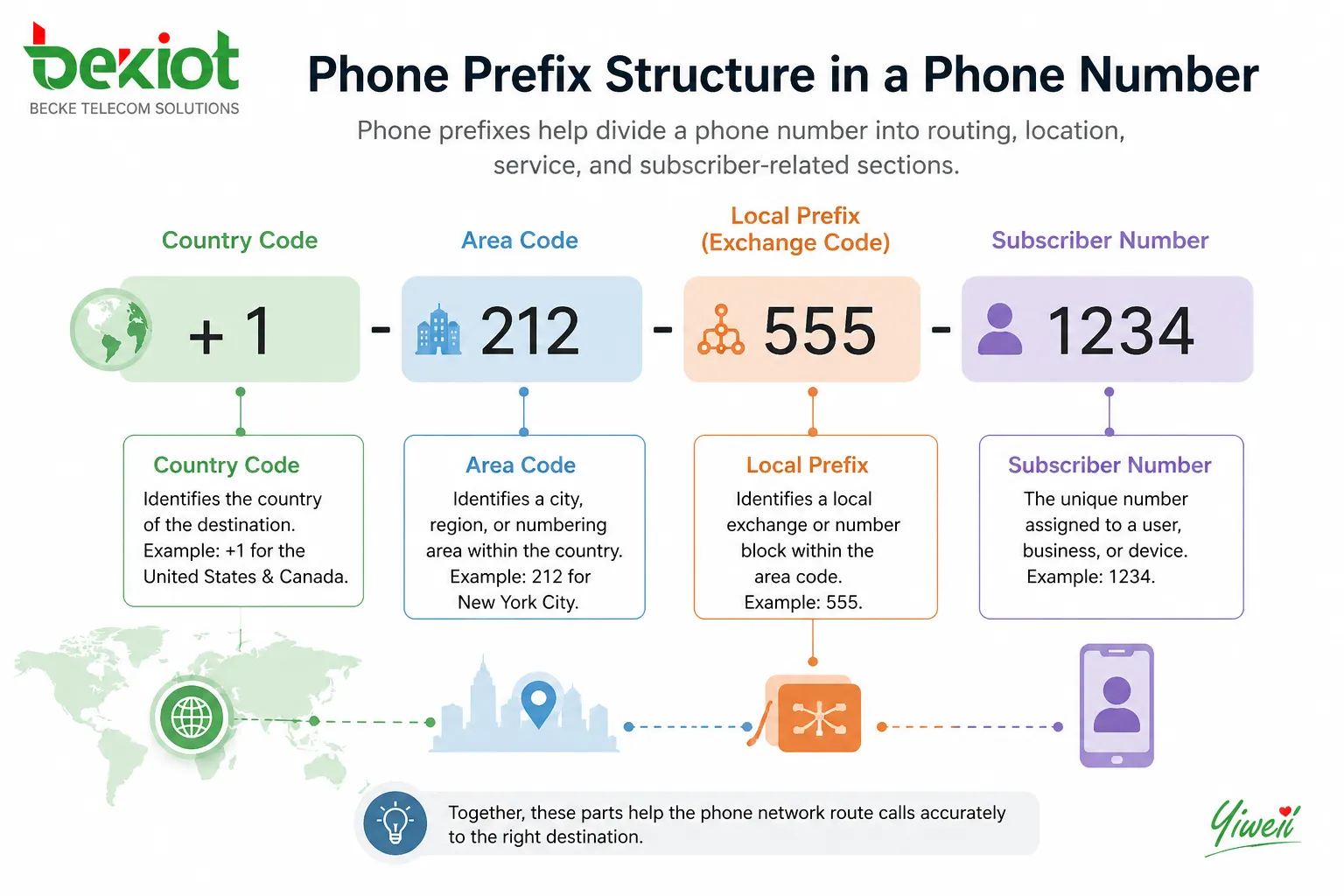
A country code is used for international calling. It appears after the international dialing symbol “+” or after an international access code. For example, “+1” is used for the United States and Canada, “+44” is used for the United Kingdom, and “+86” is used for China. The country code tells the global telephone network which national numbering plan should receive the call.
In business communication systems, country code handling is important for international branch offices, global customer service numbers, SIP trunk configuration, and call billing control. A PBX or SIP server may normalize numbers into international E.164 format so that calls can be routed consistently across different carriers and regions.
An international access prefix is the code dialed before a country code when making an international call from many traditional phone networks. For example, some regions use “00” before the country code, while North America commonly uses “011.” When using mobile phones or VoIP systems, the plus sign “+” often replaces the need to remember different international access prefixes.
For enterprise SIP systems, this prefix may be automatically converted by the dial plan. A user may dial a familiar international pattern, while the PBX converts the number into the format required by the SIP trunk provider. This helps reduce dialing errors and improves international call routing consistency.
An area code is a geographic prefix that identifies a city, region, or numbering area. It is commonly used in fixed-line telephone systems and some mobile numbering plans. In a phone number, the area code helps the network understand which local area should receive the call.
Area codes are especially important for public-facing business numbers. A company may choose a local area code to build regional trust, while a multi-site organization may maintain different area codes for branches, offices, service centers, or emergency contact points. In SIP trunking and IP PBX deployment, area code recognition can support local routing, caller ID presentation, and regional call policies.
A local exchange prefix usually refers to the first digits of the local subscriber number after the area code. In many numbering systems, this part was historically associated with a telephone exchange or central office. Although modern networks are more flexible, the exchange prefix can still help identify number blocks, service providers, or routing areas.
For example, in a number structure like “area code + prefix + subscriber number,” the prefix may be the middle three digits in some countries. This type of phone prefix is common in discussions about local phone numbers, number allocation, and caller location identification.
A mobile network prefix is a leading digit group used in mobile phone numbers. It may indicate the mobile service provider, number category, or original network assignment. In some countries, mobile prefixes can help users recognize whether a number belongs to a mobile network, a fixed network, or a special service.
However, number portability can reduce the accuracy of this assumption. A number may have been moved from one carrier to another, so the original mobile prefix may not always identify the current operator. For enterprise routing, this means businesses should rely on carrier data, SIP trunk rules, or number lookup services instead of assuming that the prefix always reflects the current network.
Some prefixes identify special services such as toll-free numbers, premium-rate services, emergency hotlines, short codes, or customer service numbers. These prefixes may not represent a location. Instead, they define the service type, charging model, or call handling priority.
In enterprise and public service environments, service prefixes are often used to separate normal calls from urgent calls, help desk calls, security calls, maintenance calls, and emergency calls. A well-designed dial plan can assign special prefixes for different response workflows, making it easier for users to reach the right team quickly.
An area code is one specific type of phone prefix. It usually identifies a geographic region. A phone prefix, however, is a broader term. It can refer to a country code, area code, exchange code, mobile prefix, trunk access code, or internal routing code. In other words, every area code can be considered a prefix, but not every prefix is an area code.
This distinction matters when configuring phone systems. If a PBX administrator only treats prefixes as area codes, the system may fail to handle international calls, service numbers, internal extensions, or external trunk access correctly. A complete dial plan should consider all prefix types that users may dial.
An extension is usually an internal number assigned to a user, department, device, or function inside a business phone system. For example, an office may use extension 201 for reception, 305 for security, and 801 for a control room. A phone prefix may be used inside these extension numbers to organize groups. For example, all numbers starting with “2” may belong to administration, while numbers starting with “8” may belong to emergency communication devices.
In industrial communication systems, extension prefixes are very useful. Emergency phones, SIP intercoms, explosion-proof telephones, tunnel help points, paging consoles, and control room dispatch terminals can be assigned structured extension ranges. This makes the system easier to manage, maintain, and expand.
A good phone prefix plan does not only make dialing easier. It also helps the communication system understand call priority, destination type, routing path, and operational role.
When a user dials a number, the phone system checks the leading digits. These leading digits are compared with predefined routing rules. If the number starts with an international prefix, the system may send it to an international SIP trunk. If it starts with a local area code, the system may route it through a local carrier. If it starts with an internal extension prefix, the system may keep the call inside the PBX.
This process is called prefix-based routing. It is widely used in PBX systems, SIP servers, SBC gateways, VoIP gateways, and carrier networks. Prefix recognition helps reduce cost, improve call quality, support failover, and ensure that urgent calls reach the correct destination.
A dial plan defines how a communication system interprets numbers. It may specify which prefixes are allowed, which digits should be added or removed, which trunk should be selected, and how calls should be transformed before being sent out. For example, a company may require users to dial “9” before an external number. The PBX then removes the “9” before sending the call to the carrier.
Dial plans can also support emergency rules. For example, calls beginning with an emergency prefix can be routed to the control room, trigger alarm linkage, display the caller location, activate recording, or notify dispatch operators. In mission-critical environments, this type of prefix logic can support faster and more reliable response.
Number normalization converts different dialing formats into a consistent standard format. For example, a user may dial a local number, a national number, or an international number. The phone system can normalize these formats into a unified structure before routing the call. This is common in SIP trunking, UC platforms, contact centers, and multi-site enterprise communication systems.
Without normalization, the same destination may appear in multiple formats, which can cause routing errors, caller ID inconsistency, and reporting problems. Prefix rules make normalization possible by identifying which part of the number should be interpreted as country code, area code, local prefix, or extension.
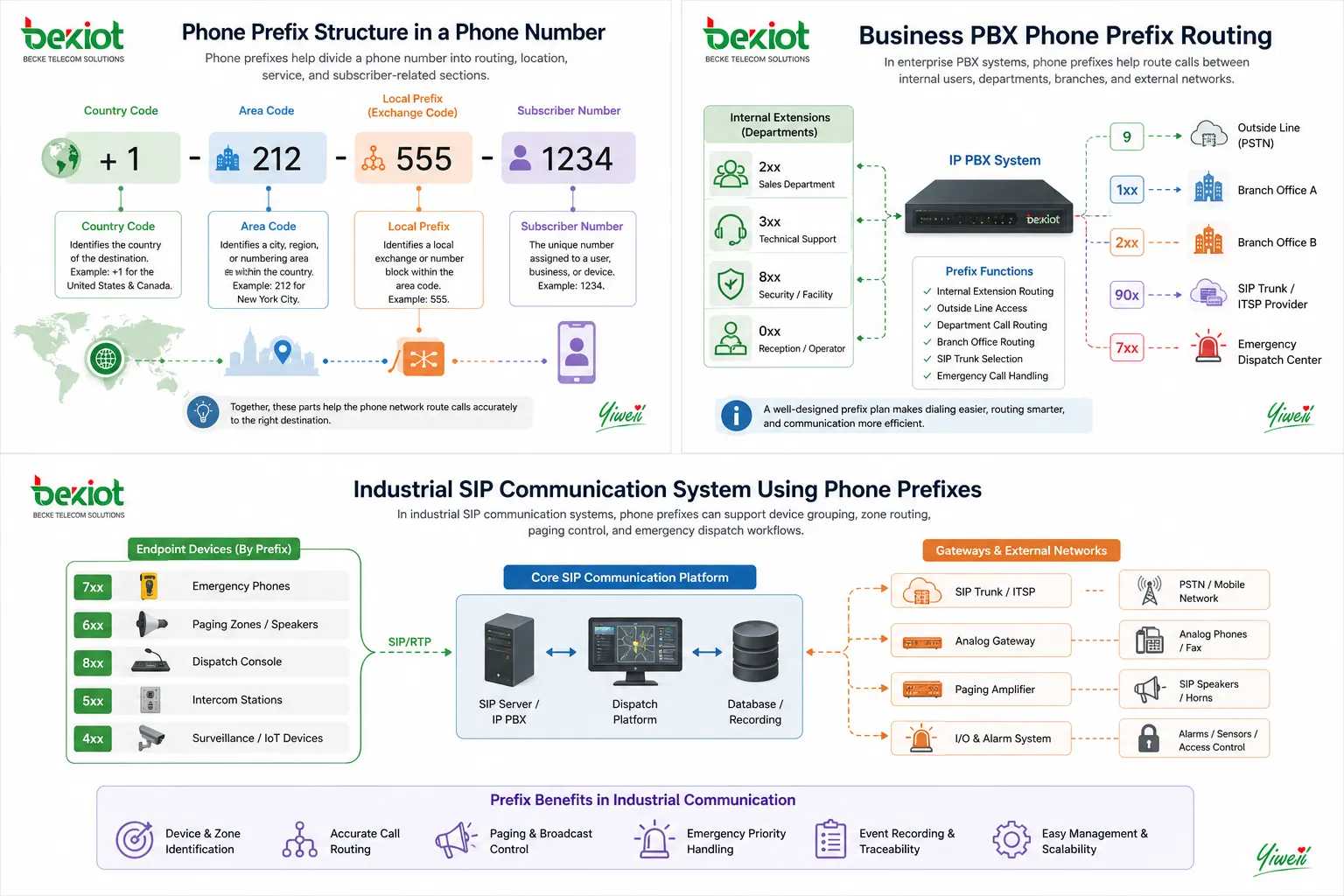
In a public telephone number, a prefix may help identify the country, region, or local number block. A simplified number structure may include a country code, area code, local exchange prefix, and subscriber number. Each section gives the telephone network more information about the destination.
For example, a business contact number on a website may include “+ country code + area code + local number.” The country code helps international users dial correctly. The area code helps identify the region. The local prefix and subscriber number complete the destination.
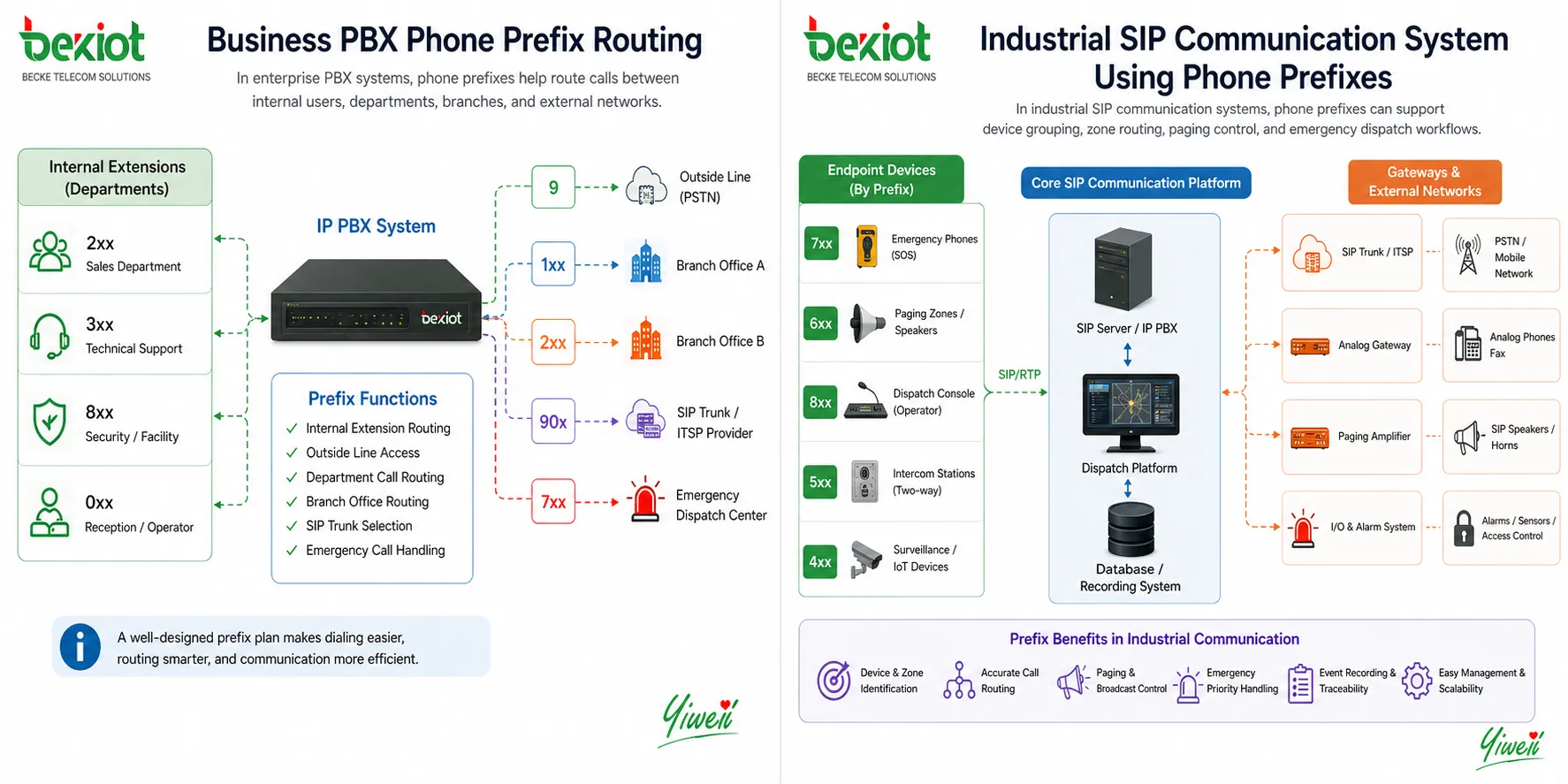
In an office PBX, users may dial “0” for reception, “9” for an outside line, “2xx” for sales, “3xx” for technical support, and “8xx” for security or facility management. In this case, the prefix helps organize internal extensions and define routing behavior.
This structure is simple but powerful. New users can understand the numbering logic quickly, and administrators can expand the system without rebuilding the entire dial plan. If the company adds another department, it can assign a new prefix range and keep the system organized.
In an industrial site, phone prefixes may be used to identify communication zones. For example, emergency telephones in tunnels may start with “7,” paging consoles may start with “6,” control room terminals may start with “8,” and maintenance intercoms may start with “5.” When an operator sees the caller ID, the prefix can immediately indicate the device category or site area.
This is useful for tunnels, factories, mines, ports, substations, petrochemical plants, campuses, and transportation hubs. A structured prefix plan supports faster fault location, easier device management, and more effective dispatch response.
Phone prefixes help businesses organize users, devices, departments, and locations. Instead of assigning random numbers, a company can build a logical numbering plan. This makes internal dialing easier and reduces confusion when the organization grows.
For example, one branch can use extensions beginning with “1,” another branch can use “2,” and a warehouse can use “3.” Emergency phones, paging devices, and service desks can also have dedicated prefix ranges. This gives administrators a clear structure for daily operation and future expansion.
Prefix-based routing can help businesses choose the best call path. Local calls may be routed through local trunks, international calls through selected SIP trunk providers, mobile calls through mobile gateways, and internal calls through the private network. This can reduce call costs and improve reliability.
In multi-site environments, prefixes can also support least-cost routing and failover. If one trunk or network path fails, the PBX or SBC can use another route based on the same prefix logic. This improves communication continuity for business-critical operations.
Phone prefixes can be used to control which users are allowed to make certain calls. A company may allow general employees to dial local numbers, restrict international numbers, and permit only authorized users to dial premium-rate or external trunk prefixes. This helps reduce misuse and supports better telecom cost management.
In industrial and public safety systems, prefix rules can also protect emergency channels. Emergency call prefixes can be prioritized, recorded, monitored, or routed to trained operators. Non-emergency calls can follow normal routing paths without interfering with critical communication.
In SIP communication, phone prefixes are commonly used in IP PBX systems, SIP servers, SIP trunks, and Session Border Controllers. The system analyzes the dialed number and determines whether the call should stay internal, go to another branch, pass through a SIP trunk, or connect to a gateway.
For example, a SIP server may route numbers beginning with “10” to headquarters, “20” to a remote branch, “30” to an analog gateway, and “90” to an external SIP trunk. This type of prefix design makes VoIP systems flexible and scalable.
Phone prefixes are also important when connecting SIP systems with analog telephone lines, PSTN lines, E1 trunks, GSM gateways, or radio-over-IP gateways. The PBX needs to know which number patterns should be sent to which gateway. A correct prefix plan reduces routing conflicts and improves interoperability.
For example, calls to legacy analog phones may use one prefix, calls to mobile networks may use another prefix, and calls to radio dispatch channels may use a separate prefix. This allows old and new systems to work together under one unified communication platform.
In SIP-based paging and emergency communication systems, prefixes can identify paging zones, alarm groups, emergency call points, and operator consoles. A paging prefix may call a single zone, a group of speakers, or an all-call broadcast. An emergency prefix may trigger dispatch screen pop-up, event logging, recording, and CCTV linkage.
This is especially valuable in industrial communication because the phone system is often connected with paging amplifiers, SIP horn speakers, intercom terminals, alarm systems, access control, and dispatch software. Prefix design becomes part of the whole operational workflow, not just a telephone numbering detail.
Industrial communication systems often include many endpoint types: SIP phones, industrial telephones, explosion-proof phones, emergency call stations, paging consoles, intercom panels, speaker zones, gateways, and dispatch terminals. Assigning different prefix ranges to each device category helps administrators identify devices faster.
For example, emergency phones may use one prefix range, production-area intercoms another range, and control room consoles another range. This makes maintenance records clearer and helps operators understand incoming calls quickly during abnormal events.
Large facilities may divide communication numbers by site, floor, tunnel section, platform, workshop, building, or process area. A tunnel system may use a different prefix for each tunnel section. A power plant may use different prefixes for the control room, turbine hall, substation area, and security gate. A port may use prefixes for terminals, warehouses, gates, and dispatch offices.
Zone-based prefixes help link phone numbers with physical locations. When an emergency phone calls the control room, the caller ID prefix can help operators identify the approximate site area even before checking the map or device database.
Some systems use prefixes to distinguish normal calls from urgent calls. A normal maintenance call may use a standard extension range, while emergency calls may use a special prefix that receives higher priority. The system can then route urgent calls to dispatch operators, activate alarm workflows, and record response actions.
Priority-based prefix planning is useful for emergency dispatch, PAGA systems, tunnel communication, campus security, railway stations, energy facilities, and hazardous industrial environments. It helps ensure that critical calls are not treated the same as ordinary conversations.
In a mission-critical communication system, prefix planning should match the real operating structure of the site: departments, zones, risk levels, devices, operators, and emergency workflows.
One common problem is overlapping prefixes. For example, if one department uses extension range “20x” and another route uses prefix “2” for external access, the PBX may not know which rule should be applied first. This can cause delayed dialing, wrong routing, or failed calls.
To avoid this problem, administrators should design non-conflicting number ranges and define clear digit matching rules. Longer and more specific patterns should usually have priority over shorter and more general patterns.
Users may dial the same number in different ways. Some may use a local format, some may use a national format, and others may use international format. Without number normalization, the PBX may treat these as different destinations. This can affect call records, routing, redial, contact lists, and caller ID matching.
A good dial plan should support common user habits while converting numbers into a consistent routing format. This is especially important for companies with multiple branches, mixed SIP and analog systems, or international operations.
Phone prefix plans often become difficult to maintain when they are not documented. As new departments, devices, trunks, and branches are added, old rules may remain in the system and create conflicts. Poor documentation can also make troubleshooting slower during outages or emergency events.
Businesses should keep a clear numbering plan document. It should include extension ranges, trunk prefixes, emergency prefixes, site prefixes, gateway routes, service numbers, and special restrictions. For industrial communication systems, it should also map prefixes to devices, locations, and operational roles.
A prefix plan should be easy to understand. Use different digit ranges for different departments, sites, device types, or call functions. Avoid random assignment when possible. A logical plan saves time for users, administrators, operators, and maintenance teams.
For example, all control room numbers may start with one prefix, all emergency devices with another, and all paging zones with another. This structure helps the system grow without becoming confusing.
A common mistake is using all available number ranges too early. When the business expands, there may be no clean prefix range left for new branches, departments, or device categories. This can force administrators to create irregular rules that are harder to manage.
It is better to reserve unused ranges for future expansion. Industrial sites should also consider future devices such as additional emergency phones, SIP speakers, alarm panels, intercom terminals, and dispatch seats.
Not all calls have the same importance. Emergency calls, security calls, alarm calls, paging calls, and operator calls may need special routing rules. Prefixes should reflect these priorities where possible, allowing the PBX or SIP server to handle urgent communication differently from normal calls.
This is especially important in harsh or high-risk environments where communication delays can affect safety. A well-planned prefix structure can support faster recognition, automatic routing, operator awareness, and response traceability.
Becke Telcom provides industrial communication products and integrated solutions for enterprise, industrial, transportation, energy, tunnel, campus, and public facility environments. In these systems, phone prefix planning is often connected with SIP server configuration, IP PBX routing, emergency telephone deployment, paging zone design, gateway integration, and dispatch platform operation.
For example, Becke Telcom solutions may include SIP phones, industrial telephones, explosion-proof telephones, emergency intercoms, SIP paging speakers, IP amplifiers, dispatch consoles, SIP servers, IP PBX platforms, SBC gateways, and analog or mobile gateways. A structured prefix plan helps these devices work together as one communication system.
In a Becke Telcom industrial communication solution, prefixes can be used to organize devices by site, zone, function, and priority. Emergency telephones can have dedicated ranges, paging zones can have independent call codes, and control room terminals can be assigned clear operator extensions. This helps operators identify calls, launch broadcasts, coordinate response, and manage events more efficiently.
For mission-critical sites, Becke Telcom can support communication architectures that combine voice calling, paging, alarm linkage, video integration, and dispatch management. Prefix planning is one practical part of this architecture because it connects dialing behavior with system logic and operational workflows.
A phone prefix is the leading part of a phone number that helps identify location, service type, network path, internal extension group, or routing behavior. It may refer to a country code, area code, local exchange code, mobile prefix, service prefix, trunk access code, or PBX extension prefix. The meaning depends on the communication environment.
For modern businesses and industrial communication systems, phone prefixes are essential for clear numbering, accurate routing, cost control, emergency handling, gateway integration, and long-term system expansion. A good prefix plan makes a phone system easier to use, easier to manage, and more reliable during daily operation and critical events.
For enterprises, factories, tunnels, transportation hubs, energy sites, campuses, and public facilities that need structured voice, paging, intercom, and dispatch communication, Becke Telcom can provide industrial SIP communication products and solution design support based on real site requirements.
A phone prefix means the leading digits in a phone number or dialing pattern. It helps identify where the call should go, what type of number it is, or how the call should be routed.
An area code is a type of phone prefix, but the word “phone prefix” is broader. It can also refer to country codes, exchange codes, mobile prefixes, service prefixes, trunk access codes, or internal PBX prefixes.
In a business phone system, a prefix may be used for outside line access, department extension ranges, branch routing, SIP trunk selection, emergency calling, paging zones, or gateway routing.
Dialing 9 is a common trunk access prefix. It tells the PBX that the user wants to place an external call instead of calling an internal extension.
Yes. Emergency prefixes can help route urgent calls to dispatch operators, identify device locations, trigger alarm workflows, prioritize calls, and support response records in industrial or public safety systems.