

The Becke PA-BGS-60W is a SIP network one-way on-demand integrated broadcast amplifier developed for projects that need dependable IP audio delivery, flexible broadcast control, and easy system management in one compact unit. It is designed for environments where daily announcements, scheduled playback, emergency voice messaging, and centralized remote maintenance all need to work together without adding unnecessary complexity to the installation.
Compared with a traditional amplifier that only focuses on output, the PA-BGS-60W is built as a smarter network broadcast endpoint. It combines SIP-based communication capability, multiple control methods, remote web access, local audio interfaces, and dependable amplifier design, making it suitable for schools, factories, campuses, transport sites, commercial properties, and community public address systems.
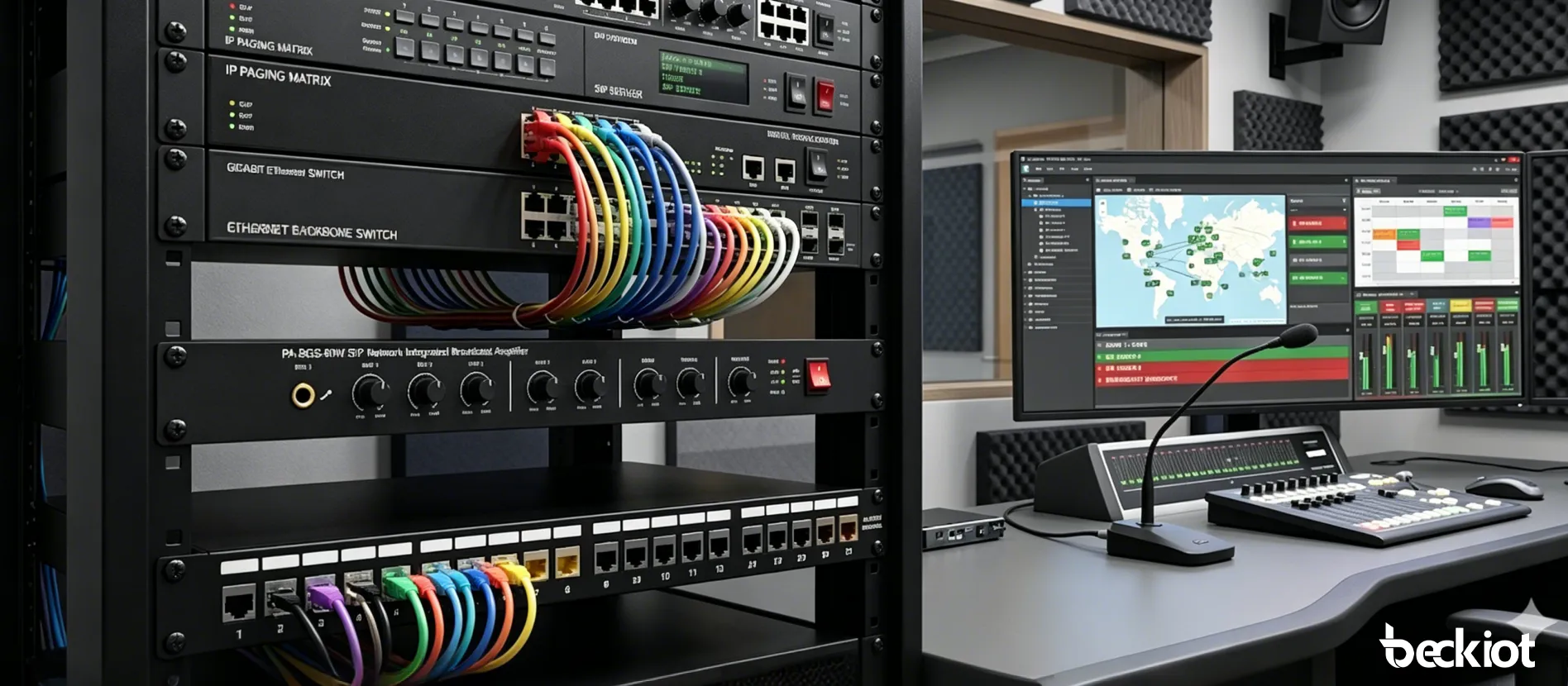
The PA-BGS-60W is positioned for projects that do not need oversized output but still require stable, professional-grade broadcast performance. Its 60W amplifier design makes it well suited to classrooms, offices, corridors, retail areas, service counters, waiting areas, workshops, and other medium-to-small coverage zones where speech clarity and controlled daily operation are more important than excessive power.
This output level gives integrators a useful option for distributed systems where multiple amplifier points are preferred over one large centralized amplifier. In real projects, that can improve zoning flexibility, simplify wiring, and make the system easier to expand over time.
The PA-BGS-60W uses a domestic dual-core ARM Cortex-A7 processor with a main frequency of up to 1.2GHz. This helps provide a stable hardware foundation for long-term IP audio operation while supporting stronger system autonomy and dependable control at the device level.
The unit runs on a deeply customized Linux operating system and includes a built-in watchdog monitoring mechanism. Together, these features support stronger robustness, better security, and more reliable long-duration operation. With mean trouble-free operation exceeding 10,000 hours, the PA-BGS-60W is clearly designed for real deployment conditions rather than occasional use.
One of the strongest advantages of the PA-BGS-60W is its flexibility in receiving and executing broadcast tasks. It supports integrated dispatch from a broadcast server, network dispatch console, intercom phone, and mobile app. This gives users more freedom in how they manage the system and allows different operating roles to work from the most convenient control point.
In practical use, the amplifier can support background music, timed broadcasts, TTS voice synthesis, emergency paging, radio live streaming, and alarm broadcasting. That makes it useful not only for daily scheduled communication but also for urgent message delivery when a site needs to respond quickly and clearly.
The PA-BGS-60W provides a complete web remote management interface. Users can access the device through a browser by entering its IP address, then configure system parameters such as network settings, SIP account information, volume levels, online packet capture, and firmware upgrades. This reduces maintenance workload and makes the amplifier easier to manage across distributed installations.
For engineering teams, this is more than a convenience feature. It helps shorten commissioning time, improves remote troubleshooting efficiency, and supports smoother long-term maintenance, especially when multiple devices are installed across different buildings or zones.
In addition to browser-based management, the PA-BGS-60W also supports configuration through a dedicated client application. These two configuration approaches give installers and maintenance teams more flexibility depending on project habits and technical requirements.
The amplifier supports both DHCP and static IP modes, and it also supports cross-subnet search and configuration. This can be especially useful in larger projects where devices are spread across different network segments and quick discovery matters during deployment and service.
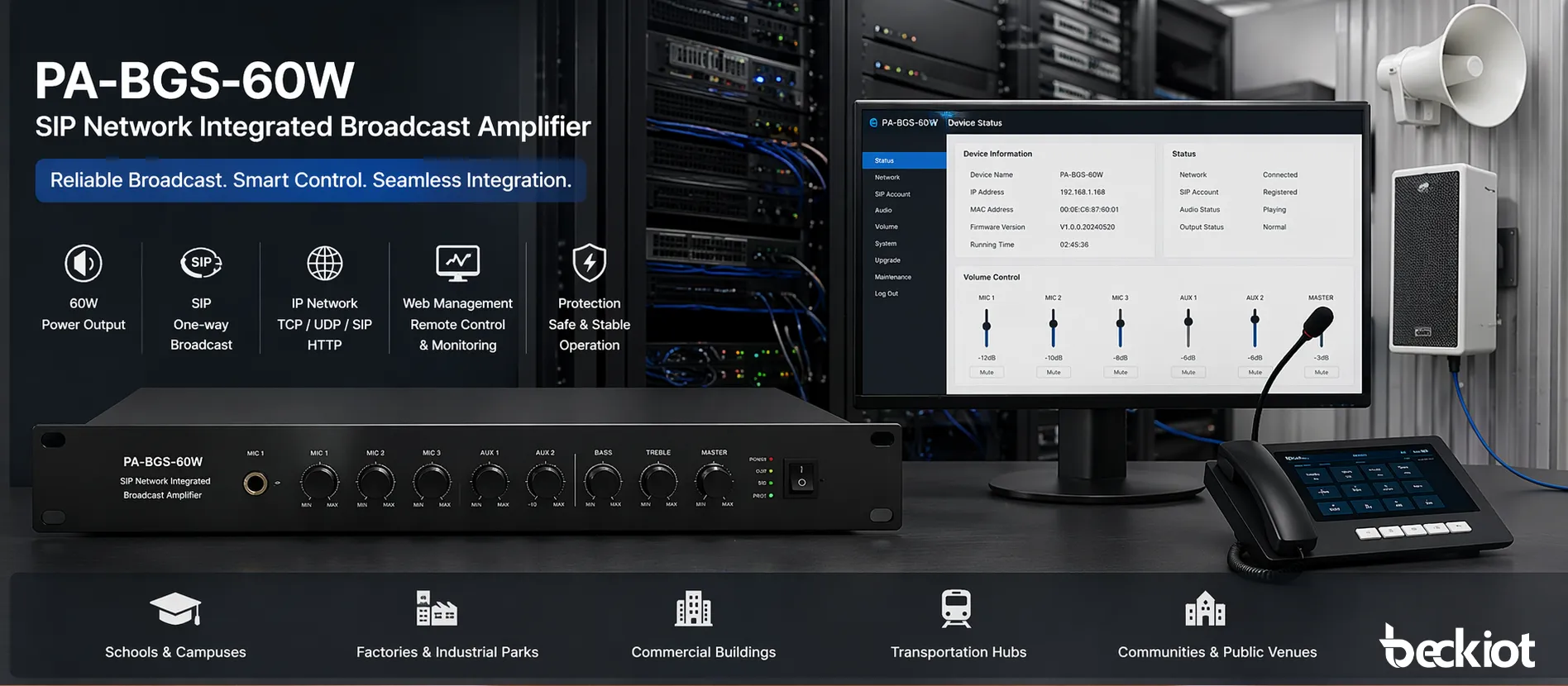
The PA-BGS-60W integrates a network audio codec module and supports TCP/IP, UDP, SIP, and HTTP protocols. This allows it to fit into a wide range of IP audio architectures, from standard network broadcasting systems to SIP-based paging environments and mixed communication platforms.
Because it supports 16-bit stereo CD-quality audio transmission and is compatible with both MP3 and WAV formats, the amplifier can deliver clear announcements and stable playback quality for routine broadcast tasks. It works well in systems where speech clarity, centralized scheduling, and remote control all need to coexist.
The PA-BGS-60W includes two AUX inputs and three MIC inputs, with independent volume and bass/treble adjustment controls. This gives users practical local audio flexibility for microphones, auxiliary program sources, and different usage habits at the site level.
One particularly valuable feature is local paging during network interruption. This helps preserve basic on-site voice communication even if the normal IP link is unavailable. For users managing schools, factories, or service facilities, that kind of local fallback is a meaningful operational advantage.
The amplifier also includes two auxiliary audio output interfaces, allowing external power amplifiers to be added when needed. These outputs use standard RCA connectors, making field wiring simple and convenient.
That means the PA-BGS-60W is not limited to a fixed deployment scale. It can start as a standalone network amplifier in a smaller zone and later become part of a wider audio distribution system if project requirements grow.
The PA-BGS-60W uses Class-D power amplification technology together with a full-loop feedback network to further reduce distortion. This helps the amplifier maintain stable output characteristics and stronger audio integrity even when it is used regularly for announcements, alerts, and scheduled content.
For end users, the benefit is straightforward: clearer voice delivery, more efficient output behavior, and dependable operation in daily broadcast scenarios.
Dual PFC switch-mode power supply technology helps improve amplifier performance while reducing unnecessary power current consumption. With support for a wide voltage range from AC90V to AC265V, the PA-BGS-60W adapts more easily to different power environments and supports broader deployment flexibility.
This is especially useful for multi-site projects or installations where electrical conditions may not always be identical. It helps improve consistency and reduces the risk of deployment restrictions caused by local power differences.
The PA-BGS-60W supports a soft-start function that helps prevent high inrush current during power-on, reducing interference to other equipment connected to the same electrical environment. This improves startup behavior and helps support cleaner system operation in professional installations.
Its intelligent cooling system automatically adjusts according to temperature changes, helping keep fan noise low while maintaining effective heat dissipation. In addition, the amplifier supports intelligent energy-saving operation. When there is no signal, it can automatically enter standby mode, with standby power consumption controlled at 10W or below.
The amplifier includes multiple intelligent protection functions, including soft start, DC protection, short-circuit protection, overheat protection, overload protection, and limiter protection. These features help improve long-term operational confidence and reduce the risk of damage under abnormal conditions.
Status indicators for level, protection, and standby conditions make the amplifier easier to inspect and maintain. The PA-BGS-60W also supports lightning protection with resistance to 4KV-level surge impact, adding another layer of field-readiness for real installations.
The PA-BGS-60W is a strong fit for education projects that need reliable daily announcements, classroom notices, scheduled bells, corridor paging, and emergency messages. Its manageable power level and flexible control options make it especially suitable for distributed campus audio points.
In factory environments, the amplifier can support shift notices, safety reminders, work area announcements, and emergency voice broadcasting. The local microphone inputs and network-based dispatch capability make it practical for both central control rooms and smaller operational zones.
The PA-BGS-60W also works well in shops, office buildings, front desks, service halls, and mixed-use commercial areas. It can handle background music, timed messages, service announcements, and daily paging without requiring an oversized system footprint.
For stations, waiting areas, ticket halls, community centers, and municipal service points, the amplifier supports a balanced mix of scheduled broadcasting, live paging, and centralized remote management. This makes it a useful option for public-facing communication systems that need both routine efficiency and emergency readiness.
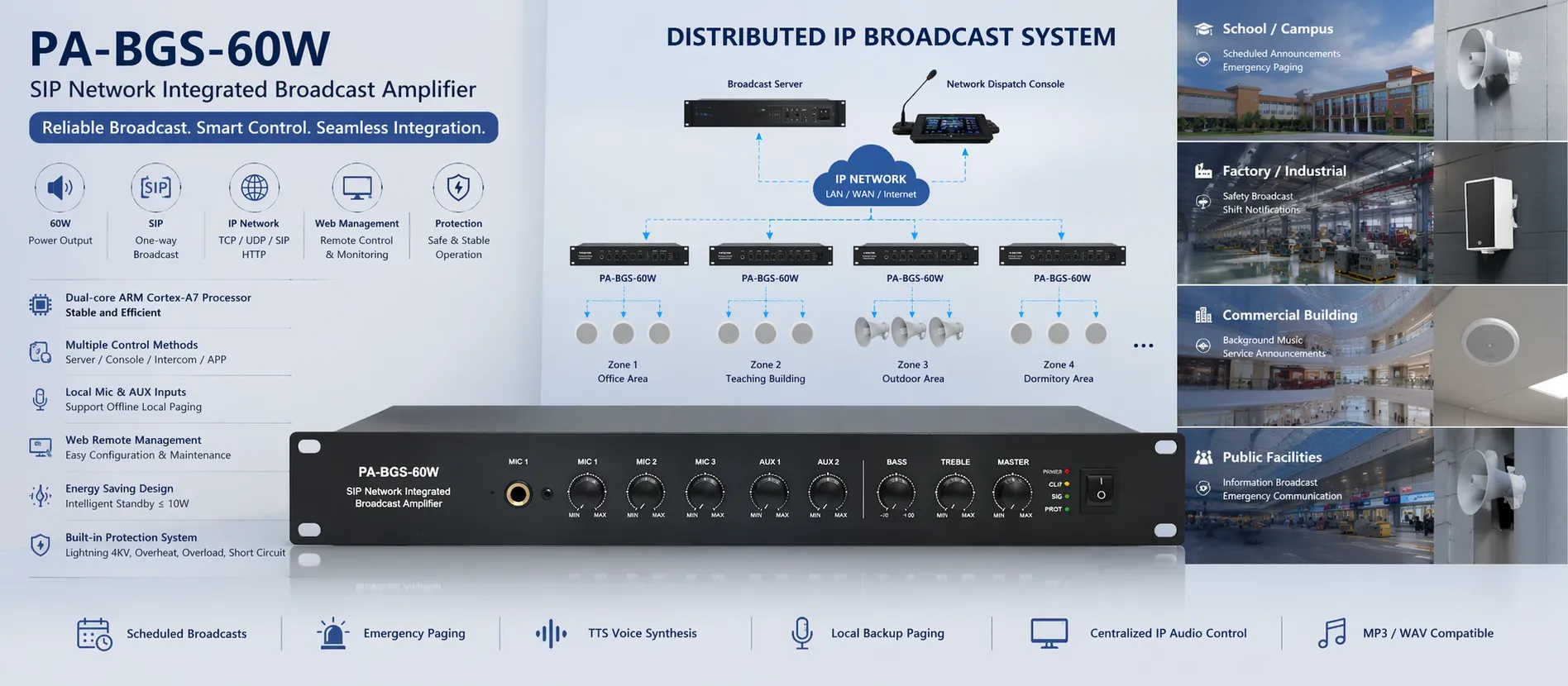
The PA-BGS-60W is not simply a smaller version of a high-power broadcast amplifier. Its value comes from how well it fits practical IP audio projects that need compact output, strong network capability, easy deployment, and dependable daily use. It brings together SIP compatibility, multiple dispatch paths, local backup paging, remote web control, protocol flexibility, and efficient amplifier design in one device.
For users who want a broadcast amplifier that is easier to deploy, easier to manage, and better suited to medium-scale voice communication needs, the PA-BGS-60W provides a very balanced solution. It is especially useful where distributed control points, space-conscious installations, and stable routine operation matter more than raw output size.
The PA-BGS-60W is ideal for schools, campus buildings, offices, workshops, shops, service areas, transport spaces, and other medium-to-small broadcast zones that need SIP-based network audio, scheduled announcements, and emergency voice communication.
Yes. It supports local paging functionality during network interruption, which helps maintain basic on-site voice communication even when the normal network path is unavailable.
Users can manage the amplifier through a web browser or a dedicated client. It supports configuration of network parameters, SIP account settings, volume control, online packet capture, and firmware upgrades, with support for DHCP, static IP, and cross-subnet configuration.
It can work with broadcast servers, network dispatch consoles, intercom phones, mobile apps, microphones, auxiliary audio sources, and network audio streams, while also supporting MP3 and WAV playback within modern IP broadcast systems.
| Item | Specification |
|---|---|
| Model | PA-BGS-60W |
| Network Interface | Standard RJ45 Input |
| Transmission Rate | 10/100 Mbps |
| Supported Protocols | TCP/IP, UDP, SIP, HTTP |
| Audio Formats | MP3, WAV |
| Audio Mode | 16-bit Stereo, CD-quality Sound |
| Sampling Rate | 8 kHz ~ 16 kHz |
| Tone Control | Bass: ±10 dB at 100 Hz; Treble: ±10 dB at 10 kHz |
| Input Sensitivity & Input Impedance |
MIC1/2/3: 5 mV / 600 Ω, unbalanced TRS input AUX1/2: 350 mV / 10 kΩ, unbalanced RCA input |
| Output Sensitivity & Output Impedance | MIX OUT: 1000 mV / 470 Ω, unbalanced RCA output |
| Overload Source EMF |
MIC1/2/3: > 12 dB, unbalanced TRS input AUX1/2: > 20 dB, unbalanced RCA input |
| Input Channels | 2 x AUX (line) inputs + 3 x MIC (microphone) inputs |
| Rated Power | 60 W |
| Standby Power Consumption | < 10 W |
| Frequency Response | 80 Hz ~ 16 kHz (+1 / -3 dB) |
| Signal-to-Noise Ratio | MIC1/2/3: 66 dB; AUX1/2: 80 dB |
| Total Harmonic Distortion (THD) | 0.5% at 1 kHz, 1/3 rated output power |
| Channel Crosstalk Attenuation | ≤ 50 dB |
| Output Mode | 100 V constant-voltage output (amplitude limit: 135 V) |
| Cooling | Front-to-rear forced air cooling; built-in fan activates at 55 °C heatsink temperature |
| Protection Circuits | Soft start, DC protection, short-circuit protection, overheat protection, overload protection, amplitude limit protection |
| Lightning Protection | 4 kV surge lightning protection |
| Power Supply | AC 90–265 V / 50 Hz |
| Material | Black aluminum panel, SPCC cold-rolled steel chassis |
| Dimensions | 484 × 210 × 45 mm |
| Weight | 2.60 kg |
| Operating Temperature | 5 °C ~ 40 °C |
| Operating Humidity | 20% ~ 80% relative humidity, non-condensing |